Thursday, 24 May 2012

Lake Angelus


Day 1

I decide to return to Nelson Lakes National Park, for what will probably be my last couple of New Zealand tramps. I was here for a few days earlier on in the summer, but at that time I was resting my feet, so was only able to do short walks. The scenery is stunning and there is a maze of tracks and lots of huts to stay in, making the area a tramper's paradise. I thought then that I would try and get back to this area on my return journey to Nelson and just now I seem to be lucky with the weather at the moment. There has been a fall of snow on the tops of the mountains, but not too much and the weather is set fair for the next week. 


I camp at the site right by the lakeside at St Arnaud and spend a day making my plans. There are many tramps to choose from in this area and I feel that some of them are beyond my capabities - for example too many days; or too much very steep climbing. I want one that will be enough of a challenge, but stay within the realms of enjoyment. There is an excellent visitor centre here in the village of St Arnaud, so I do my own research and talk to the Department of Conservation people and make my choice. I will do a 2 day walk, which climbs up Mount Robert and goes along a ridge to a hut located on Lake Angelus.  The return walk will be down a creek, making a good circuit walk. 


I am up at first light, as it will be a good 8 hours of walking today. The day dawns cold and clear and the lake looks beautiful, with mist rising in the early light.
Dawn at Lake Rotoiti

First of all I have to drive Josephine up to the car park at the end of the Mount Robert road, where she will wait for my return. The path starts by zigzagging steeply for about an hour and a half up the exposed face of Mount Robert. The views back down to the lake and the countryside beyond are magnificent.

Lake Rotoiti

After breaking through the bushline the gradient becomes more gentle and leads to a junction. I have been here before. Last time I stood at this junction I felt the ridge track drawing me towards it, but that time I had to turn left towards Bushline Hut and the short return to the carpark. This time there is nothing stopping me heading off along the ridge, where there is a huge expanse of wilderness beyond and on either side.

Ridge Path
 
The track climbs gradually and before long I am among the remains of the recent snow fall. Where the path takes the shady east side of the ridge the walking is a little hazardous and I take my time and am very careful with my footing.
Snow on the Ridge

The track continues to climb, passing various cairns and steep rocky outcrops that I have to negotiate, often using hands and feet. I have to stop for several rests along the way, but it is good to be able to remove my eyes from my feet and have the time to take in the view.
The next section of the track sidles across an exposed scree field of boulders, which require sure footing and once again I am very glad of my poles.


Scree

At the end of this section there is a saddle where the path divides. In one direction is the hut and in the other is tomorrow's descent.
View from the Ridge
 
There is another rather slippery shady section and then I can look down to Lake Angelus (which is actually two lakes), which is in a basin surrounded by ridges and peaks and with the hut looking out over the lakes. It is still another 30 minute descent to the hut, which requires careful negotiation. Today's walk was made more challenging by the conditions than I had envisaged. It has actually taken me over 9 hours to get here, but I am not worried about my speed - better safe than sorry.
Lake Angelus

The hut is almost brand new and sleeps 36 in two rooms, but tonight there is just the hut warden, myself and a kiwi man here. Outside there is a large deck which looks out across the lakes and I take in the last of the daylight and enjoy the reflections of the mountains in the still water. There is total silence here - no wind, no birds, no water moving - just the sound of silence. Inside we struggle to keep the fire going with wood that is rather damp and we sit around the stove to give it the attention it needs and chat in the dark.
Reflections in the Lake
 
Day 2
The early dawn light catches the top of Mount Angelus and makes it shine with a rosy glow. 
 
Dawn on Mount Angelus
 
 
Overnight the edges of the lake have frozen, but they will probably melt again during the day. Later in the winter they will be frozen solid for several months. I wait until 10 o'clock to leave, to give the sun time to get high enough to start to melt the snow, which has also frozen harder again overnight. I climb back up the ridge the wqay I came down yesterday, to the path junction at the saddle. Here tussocks of tightly-packed alpine plants show through the snow.
Alpine Plants

From here my route drops steeply down to the left following Speargrass Creek, with Mount Robert ridge, which I was struggling along yesterday towering above me.

Speargrass Creek
 

Mount Robert Ridge
 
The track crosses and re-crosses the stream, which to begin with is no problem as the stream is very small.  But with the descent the volume of the stream increases and it begins to become difficult to cross with dry feet. After a couple of crossings that see me pacing up and down the bank looking for the perfect set of stepping-stone boulders, I decide the time has come for me to be initiated into the real world of New Zealand tramping and just wade across in my boots. Having done it, it doesn't seem so bad, in fact it is very liberating and far less fuss than the messing around I was doing before and I make the next crossings with a smile on my face at how easy it is!
I stop at Speargrass Hut, where I take off my squelching boots off, drain them out, wring out my socks and leave them to dry for the time it takes me to have my lunch. The rest of the walk is relatively easy, through beech forest along the banks of the creek and as the light begins to fade in the forest  I am back at the carpark where Josephine is waiting for me.


Sunday, 29 April 2012

Indian Parcel

No way! I have just heard from Kate that the parcel I sent from India to her family has just arrived. I posted it in India in September 2011 and it arrived in Plymouth 7 months later. I had given up all hope on that one.

Here is a picture of the children wearing their Indian clothes.

Elliot and Megan in their Indian Clothes


St James Walkway Days 3 and 4

Day 3
During the night I hear the forecasted rain commence and in the morning the clouds hang low over the surrounding mountains and the rain continues to fall. Because of the weather no-one is in a hurry to make an early start, but Chris makes the first departure, togged up in her wet weather gear, while Ella, Sarah and I seriously think about staying here for the day, having a quiet day reading, as the hut is so nice and we have enough provisions for the extra day. We decide that 10 o’clock is the cut-off time to make a decision to go or to stay.
Ella and Sarah inside the Hut
Right on 10 o’clock the sun comes through a little bit, offering some hope that the day will improve and I set off just ahead of the girls. I can’t decide what the right clothing is, because it rains and then the sun comes out and then it’s too hot for waterproofs. In the first hour my waterproofs go on and come off several times and I make very little progress, other than feeling as if I have done a training session for a primary school dressing-up race. I am quite glad when the weather decides to stick to one thing, even though that is rain. The walk has a different beauty in the rain and the clouds gather quite heavily behind me, while up ahead there are occasional rainbows and the promise of better weather to come.
Rainbow

Clouds


After 5 hours I come across a little tiny historic hut. This is the Rokeby Hut, built in 1955. It has 3 canvas bunks and a small cast iron range. I decide to stop for a break and make a hot cup of tea. Soon after me, Sarah and Ella arrive, looking very cold, wet and bedraggled. They don’t have waterproof trousers and they are wet through from the hips down. With the aid of some meths from my cooking stove, we light a fire in the range with slightly damp wood and before long they are feeling better as they sit in front of the fire steaming nicely.
Drying Out

It is now only about an hour and a half to tonight’s destination, which is Boyle Flats Hut. Because of today’s late start and the break at the old hut, it is not far off nightfall when I arrive. Chris has decided to stay here tonight rather than walking out today and has lit a small fire to begin to dry off. We have to rummage in the woodshed for more small bits of firewood. This is unusual, as the huts are usually well-provisioned with wood and sometimes coal, but we manage to find enough to keep the fire going through the short evening and we arrange our wet boots around the stove and our clothes hang from lines across the room.
Arriving at Boyle Flat Hut


Day 4
The next morning the rain has stopped and the overcast sky adds a brooding atmosphere to the valley.
Clouds above the Hut

It is a relatively short walk of 15km today and the sun comes out from time to time adding a pleasant feel and smell to the damp air in the woods.
Sunshine in the Forest

Sunshine in the Valley

The last river crossing is via another swing bridge and the track heads down to the main road, where Josephine is parked safely in a car park of an outdoor education centre.
Swing Bridge over the Boyle River

I have enjoyed the different challenges of this walk. It has been th logest walk I have done, but over easier terrain. It is also the first time that I have by chance shared an entire walk with the same 3 people and I enjoyed sharing the walk and the huts with them.

St James Walkway Days 1 and 2

The St James Walkway is a long tramp of 66km and is designed to be walked over 4 or 5 days. The path follows several interconnecting river valleys and is well-formed and pretty flat, making the walking easy and unlike almost everything else I have walked here so far. I plan to try and complete the walk in 4 days, depending on the weather (which is due to deteriorate in a couple of days) and how things go, but I have enough provisions for 5 days, just in case. As I am reading the information board by a small tarn at the start of the track, I meet up with two young German girls, Ella and Sarah, who are also about to start walking. We have exactly the same walking plans as each other, so we will probably be companions along the route and in the huts.
Day 1
It is a beautiful sunny day and the path sets out on boardwalks across boggy across heath land; between small trees which are festooned with the best lichen display that I have seen so far. Over the next few hours I pass Ella and Sarah and they pass me, as the path winds pleasantly through beech forest following a small river.
Start of the Walkway

Lichen on the Trees

Path through the Beech Forest

A swing bridge crosses Cannibal Gorge and an information board here explains that the name derives from a number of human bones found here, which are likely to be the remains of a victory feast following Maori warfare between tribes, in which the winners got to eat the losers.
Cannibal Gorge

The forest opens out into a wide grassy clearing where Cannibal Gorge Hut is located. The 3 of us arrive at about the same time as each other and here we meet Ondrey, from the Czech Republic, who is in New Zealand travelling and picking fruit. He has walked in this far today and will walk out again tomorrow, as the fruit-picking calls. We have our lunch together in a sunny spot on the grass outside the hut.
Cannibal Gorge Hut

Soon after the hut, a wooden bridge crosses a small stream. The name ‘Billy Goats Gruff Bridge’ is written on the handrail. I approve of this, as every time I walk across a bridge like this I think, ‘Who’s that trip-trapping over my bridge?’
Billy Goats Gruff Bridge

Crossing the River

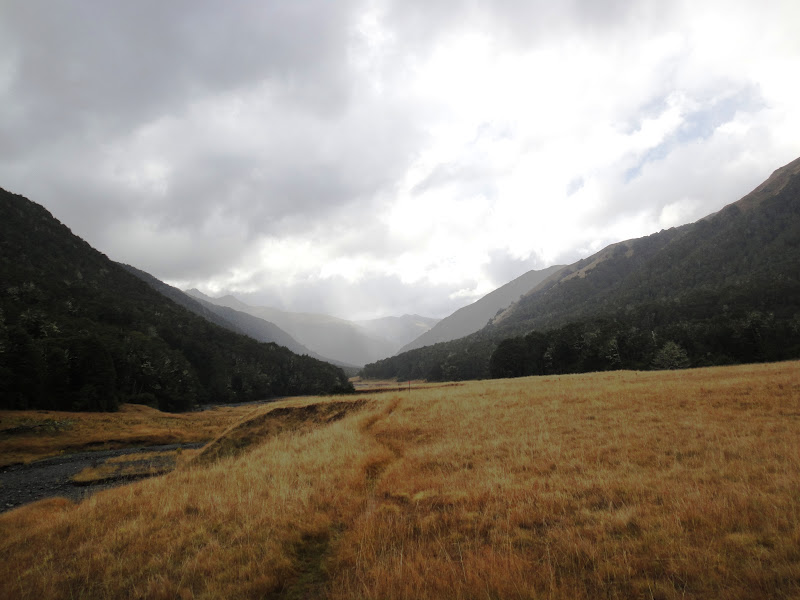
The path continues to follow the river, but now crosses more open clearings, which allow views along the river and up to the bare-topped mountains on either side of the valley. In the early afternoon the 3 of us arrive at Ada Pass Hut, which is where we will stay tonight. A bit later on another woman of about my age arrives. This is Chris, who is originally from Scotland, but who moved here with her husband about 8 years ago, buying a farm and leaving their 3 grown-up children in the UK. She secretly hopes that they might eventually follow them out here. Chris is a champion walker; what it has taken me and the German girls to walk in 4 ½ hours, she has just done in 3 ½ hours. She thinks she might do the whole walk in just 3 days. I have now met all the people there are to meet on this walk, which is in sharp contrast to last weekend’s busy walk. We light a fire in the stove and make ourselves cosy for the evening, cooking our evening meals by candle and torch-light.  Tomorrow will be the longest leg of the walk at 25km, if we are going to complete it in 4 days and we are all tucked up in our sleeping bags by 8 o’clock.
Ada Pass Hut


Day 2
We start getting up before it is properly light and as I stand at the outside sink cleaning my teeth, I think this is not a bad view from my bathroom.
View from the Hut


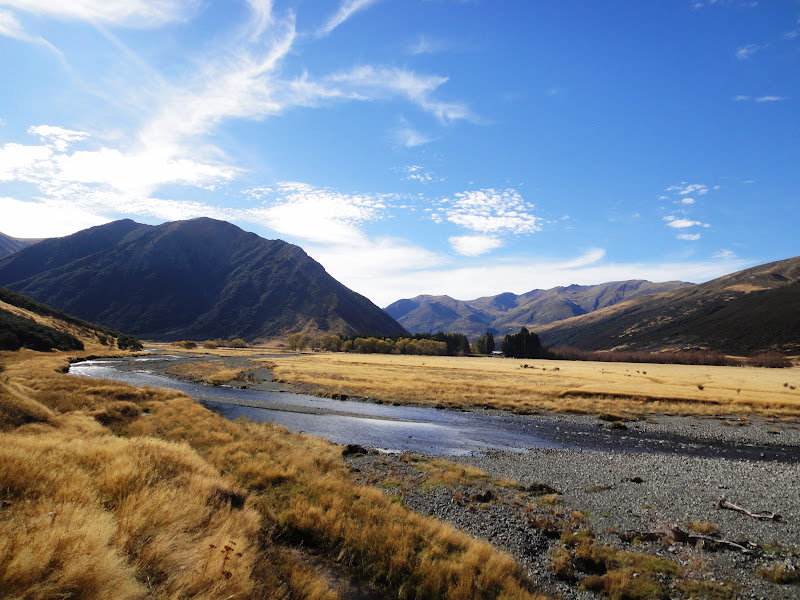
We set off around the same time as each other at about 7.30am, with the sun already shining brightly. The path goes through open grassland alongside the river and the mountains rise up on either side of the broad, flat valley floor, with a layer of cottonwool cloud lying along the mountain tops.

Grassland

Clouds on the Montain Tops

In various places the top layer of grass has been scuffed back in rough circles and Ella and I speculate that this is the work of wild pigs. As I climb over a small ridge, I hear some movement among some small scrubby trees below me and there are 3 little black pigs, rootling around. They catch sight, or sound of me and trot off into the undergrowth.
I stop at Christopher Hut for lunch with the German girls. Chris has been here and already gone on. This is where we would stay for our second night, if we are to take 5 days on the trail, but we are all feeling good and the weather looks to be set fair for the rest of the day, so we all decide to carry n to the next hut.
Christopher Hut

The afternoon’s walk continues in the same vein as this morning. I am loving the scenery and although there is a fair amount of ground to cover today, the path is incredibly well-formed and flat, so that I don’t have to watch every footstep and can stride along, taking in the scenery and the feeling of space, light and air. Maybe this walk is shaping up to be my favourite so far.
Path by the River


A gateway of thorny trees leads to the last open terrace where tonight’s hut stands in the middle of a vast open grassland and a herd of horses grazes further up the valley. Smoke is already rising from chimney, as presumably Chris has already been here for hours.
Gateway of Thorny Trees

St James Horses

Anne River Hut

This hut is brand new and lovely, having been built only last year, after the old hut burned down. Apparently a tramper cleaned out the embers of fire and left them in a plastic bucket on the wooden veranda. Unfortunately they were not completely dead, but the hut soon was.

ANZAC Day


25 April is ANZAC Day. ANZAC stands for the Australia and New Zealand Army Corps. This date marks the landing of ANZAC troops at Gallipoli in the First World War, which was the first major battle for New Zealand troops. More than 2 700 New Zealand troops died there. Interestingly Remembrance Day here is on a significant First World War date; whereas ours marks the Armistice at the end of the Second World War. As I have travelled around to the small communities in the south island I have been touched by the impact of the First World War and also the way these communities respect not only those who died in the wars, but importantly also those who returned home.  War veterans are called ‘Returned Servicemen and women’. Many historians see the First World War as very significant in New Zealand’s history – as the time when its identity as a nation was forged.  103 00 New Zealanders went overseas to fight in World War One. 18 500 died in the war and another 48 000 were wounded.
After the First World War the New Zealand Government helped to pay for war memorials to be erected and these often list the names of the servicemen and women who returned to New Zealand, as well as those who lost their lives. These memorials are often stone built archways, or sometimes more like the memorials we are used to at home. After the Second World War the Government again provided a subsidy for an appropriate memorial. This time towns often chose to erect a building, such as a Memorial Hall, or to designate a piece of ground for a park or playing field. In the Second World War 140 000 New Zealander went overseas to fight, including thousands who fought the Japanese in the Pacific. By July 1942 67% of New Zealand men between the ages of 18 and 45 were serving in the armed forces.
In the small museums in these little towns, alongside displays about the early settlers, there is almost invariably an exhibition with war memorabilia and about the effects of both wars on that community, with stories for example about how one local family lost 4 men in World War 1.
A few days before ANZAC Day I am in a little town called Methven and I stop and buy a poppy from a man who has a little table set up in the shopping arcade. I ask him some questions and he tells me that there is currently an exhibition in the Memorial Hall, so I pop over there to take a butchers and learn some more.
The hall has a couple of permanent exhibition boards about the contribution of New Zealand Servicemen and women to the First and Second World Wars and also one about the effects of the wars on the community of Methven itself.
War Exhibition Boards in Methven Hall

Methven lost 69 men in World War One. 64 families were affected, with one local family losing 3 of its menfolk.
There is also a temporary exhibition about local people who still live in Methven who returned from the Second World War. There is a current photo of each person, together with a photo or two of them during the war and some text with their own recollections from the war.  Tom was called up in 1941 at the age of 19 and served in Eygyt, Italy and Japan. He recalls seeing Hiroshima after the bomb had fallen and recalls, ‘It was just flattened; there was nothing left to see.’ As I am standing reading one of these an old man comes in and I recognise him immediately as the man I am just reading about – Tom Harrison. He has brought in another old photo of him and a couple of friends from his time in Italy.
Tom Harrison in 1941 at 19 Years Old

Tom’s War Recollections and Recent Photograph

Tom Harrison Today at 90 Years Old

On the day before ANZAC Day I am in the town of Hanmer Springs and decide to pay my respects and learn some more by going along to the dawn ceremony to see how the community marks the occasion. That night, while I am sleeping sounding in Josephine, when I am woken at midnight by the van shaking. Maybe someone is walking around the campsite in the dark and bumped into the van? But I don’t hear or see anyone.  I am a little spooked, but go back to sleep until my alarm wakes me at 5.30am and have to spend some time de-icing Josephine’s windscreen before driving the short distance into town. The ceremony will start the war memorial at 6.15am and then continue to the memorial hall.  As I park up and walk down the street towards the memorial there is a number of other people individually, or in small groups heading in the same direction. I overhear people talking about the earthquake last night. So that explains my midnight experience.
In front of the war memorial there is a small silver band waiting to play. They stamp their feet and blow on their fingers and adjust their head torches so that they shine on their music. They start by playing ‘Abide with me’  followed by, ‘I vow to thee my country’, then a couple of well-known Maori anthems, which I recognise, but I don’t know the titles.
Band

Crowd at the Ceremony

As they play the crowd gathers quietly. The community of Hanmer Springs has about 1000 residents and I guess about half of them are here. There are whole family groups, including small children. One woman wears a serviceman’s hat and medals; presumably from a family member.
In front of the war memorial there is a line of 4 empty chairs and around the memorial itself 4 soldiers in uniform stand totally still, with their heads bowed. They have guns over their shoulders and wear white gloves.  A parade of local service people in uniform march up, Dad’s Army-style. 3 very old men are with them and they take 3 of the 4 chairs in front of the memorial. These are the remaining local Second World Returned Servicemen. A local church minister takes the microphone and tells us that the 4th veteran sadly died a few days ago. I can’t help but wonder how many will fill the chairs next year and it won’t be too long before there won’t be any chairs put out.
4 Chairs and Parade

The minister invites the 3 old men to come forward and lay a wreath. Then one man takes the microphone and in his very old man voice reads part of the Laurence Binyan poem ‘For the Fallen’ (which incidently was composed on the cliffs of North Cornwall):
They shall not grow old, as we that are left grow old:
Age shall not weary them, nor the years condemn.
At the going down of the sun and in the morning
We will remember them.
Then he pauses and repeats the last line, ‘We will remember them.’
Ode of Remembrance

Then various other official groups add their wreaths to the memorial, followed by members of the public who maybe just put down a single poppy. People walk up to the memorial and back in the slightly awkward way of recognising the solemnity of the ceremony. Several people wipe tears away, or just let them fall.
After the New Zealand National Anthem, we walk slowly up the main street to the flag staff outside the Memorial Hall. In the first light of the dawn the last post is played on a bugle as the flag is lowered to half mast and then we stand in 2 minutes’ silence. 
Last Post

Standing next to me there is a group of 3 small girls, about 8 years of age. One turns to the other 2 and says very solemnly, ‘The things we do can’t change the past; but the things we do will change the future.’