Monday, 19 September 2011

Alleppey

Alleppey is the main destination for exploring the backwaters. In the guidebook it is described as the Venice of India, based on the fact that it does have a couple of canals running through it; but that is perhaps a little too romantic a description and taking the comparison too far.
View of a canal
It is the biggest town that I have stayed I so far and a main transport hub for the area. The traffic and general mayhem in the main street reflects this and buses hurtle down the roads to and from the bus station at alarming speed, with the conductor hanging out of the back and ringing his bell to let the driver know that there doesn’t seem to be an imminent collision.
In the main street above a row of shops are intricate carvings of a Hindu temple.

I took a walk to the main beach about 4km from the town. It was a strip of white sand rather like the beach on Vypin Island.
There is a long metal pier which was built by the British, but now crumbling. I sat on the sand for a while and talked to a couple of Indian men who had a day off from work. One was a traffic policeman. He said that the traffic was very dangerous and there are many accidents. Then he offered to show me around on his motorbike as he is keen to improve his English. ‘I drive very safe’, he said. I declined
Beyond the pier I could see fishing boats pulled up on the beach. I took a walk that way, getting some hassle from some groups of teenage boys who called to me and wanted to have their picture taken with me.
The boats were interesting and a group of men were just setting off for a fishing trip. I took some pictures thinking that Guy would be interested.


At the end of the boats I came to an open area of beach with a few open-sided huts and some piles of baskets. I guess this is the fish market area and the business is completed for the day. Under one roof and group of men squatted playing cards.

Traditional Keralan art - Kathakali


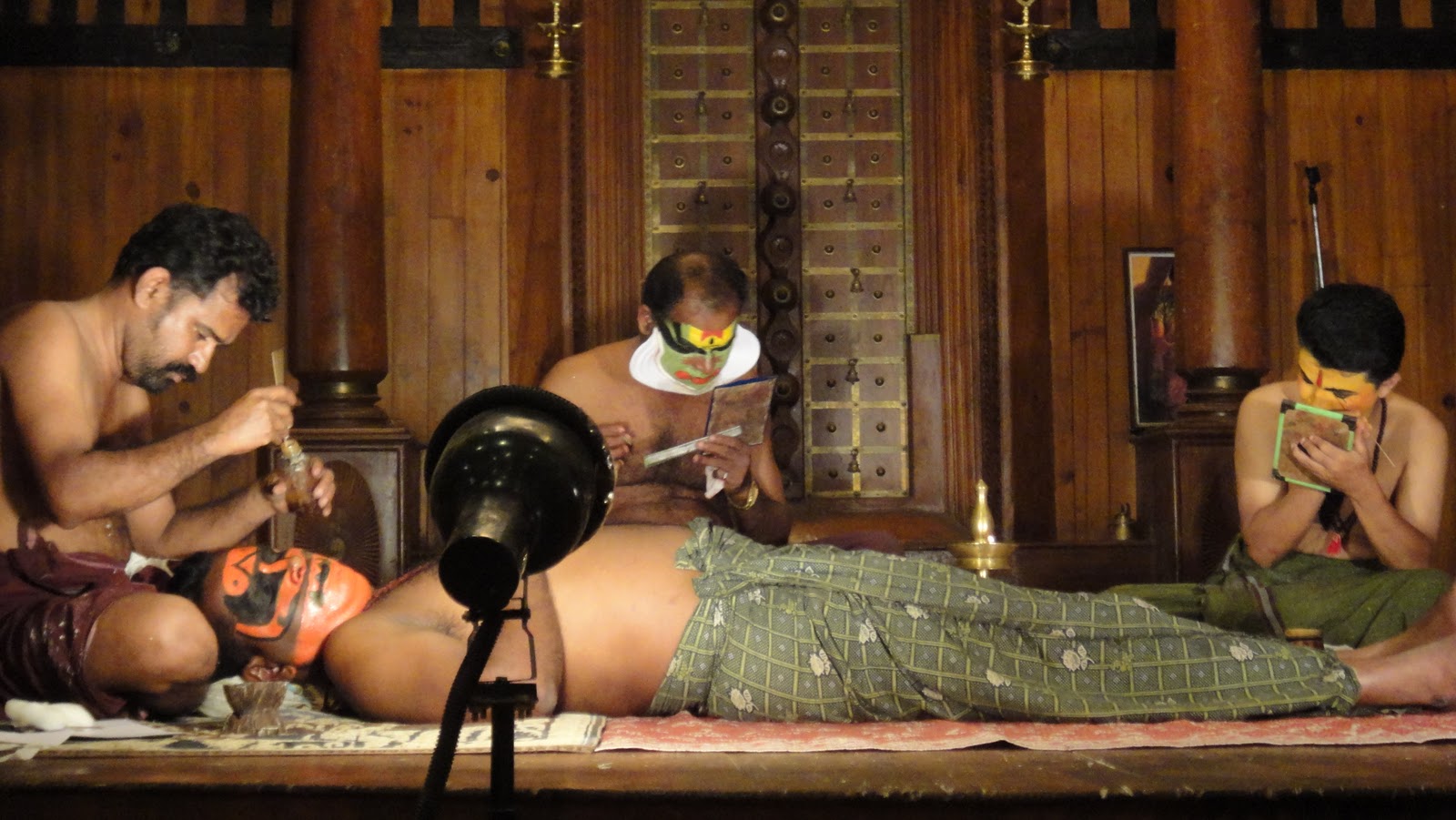
Kathakali is an art form which literally means ‘story play’. It is a mixture of dance, mime and pantomime! Drummers and singers accompany the performers who tell the story through their precise movements, particularly mudras (hand gestures) and facial expressions. The stories are the Hindu epics and usually tell about good and evil, frailty and courage, poverty and prosperity, war and peace. Originally the stories were told in the temples and went on from sunset to sunrise. Nowadays shorter versions are shown, both for tourists and to keep the traditional art alive – but it’s still a lengthy process. This is no tourist gimmick, the performers and musicians  train for 6-8 years and it is taken very seriously.

The complicated make up begins an hour before the performance. Natural dyes from rocks make the colours and the white is made from rice flour into which cardboard pieces are stuck to make the different collars and shapes around the faces. A seed from a flower is placed under the lower eye lid to dye the eyes red.

Beginning the make up

On goes the lip stick

Now they are all at it


With a little help from my friend

While this was going on the master-of ceremonies lighted lamps and decorated the front of the stage and the floor of the auditorium with patterns made from rice flour.
Floor patterns

We then had a demonstration is which one of the performers showed how facial expressions and eye movements are used to show emotions and body movements and hand gestures to portray specific words and phrases.
Demonstration of facial expressions
The main performance began. The story was about a prince who is chosen to kill an evil monster who has been terrifying a village. There are 3 characters – Prince Bhima(with green face); the monster Baka (with red/black face) and  a villager. The dress of the two main characters was almost identical with elaborate head dress and huge hooped skirt with pompoms attached – all very camp.

The prince tells the villager he will fight the monster

The murderous forest-dwelling demon

The prince and the demon prepare for battle


The drummers and singer got very excited as the story reached its climax with the fight to the death between the prince and the monster. In case you are worries about the outcome, you will be pleased to know that the monster is defeated and killed by the prince and the village is saved.
The demon is slayed - hurrah!


Wednesday, 14 September 2011

A walk in the park

I took another horrible bus for a 5 hour journey south from Munnar to Kumily, which is the town from which to visit the Periyar Wildlife Sanctuary.
The park covers 777 sq km and has a huge artificial lake created by the British in 1895. It is home to bison, sambar deer, wild boar, monkeys, 2000 elephants and 45 tigers (they count the elephants and the tigers).

I took a walk with my guide, Tangoma, who works for the park.  We put on cotton gaiters worn inside our shoes – boots for me and sandals for Tangoma (she had lost her boots). These were for protection from leeches, which are common after rain.

My guide - Tangoma

We started our walk by skirting a field of domesticated buffalo.

Buffalo

Two small boys were trying to catch small fish in the water in the field with a net made of a piece of material. I don’t know if they had any luck.

Boys fishing

We walked through a grove of enormous bamboo. I’m glad it wasn’t this kind growing by my patio!

Tangoma pointed out teak and rosewood trees. The nearby town is called Thekkady, which is named after the teak. This beautiful tree is called ‘flame of the forest’.

Flame of the forest


We walked through part of a tribal village. The people used to live and wander freely inside what is now the park. 40 years ago they were all resettled outside the park boundary. The government give them houses and provide schooling. Each house has a well for water. Outside one house two women squatted close to a fire cooking. A small naked boy ran around. One of the women was talking on her mobile phone.

Tribal village houses


These monkeys were sitting on a roof.

Monkeys


As we left the village we crossed this ‘dig’, which protects the village from elephants.

Elephant protection


We passed a man and woman carrying firewood on their heads. They spoke to Tangoma and told her that earlier in the day a guide had fallen into the ditch and broken his hand. Tangoma explained that the villagers have their own language, but also speak Malayalam and Tamil.

In the forest the crickets were load and there was the occasional bird song. Tangoma pointed them out, but I don’t remember their names except for parakeets. We climbed steeply uphill, stopping now and then for a breather and a drink of water.  I put my bag down on the ground and Tangoma said that was not a good idea. She picked it up and brushed if off underneath with her stick. There were two leeches on it. Tangoma suggested I tuck my shirt into my trousers.

 As we climbed she used a stick to break cobwebs across the path. There was a termite mound close to the path. We heard a samba deer barking lower down the hill.

We came out on a path at the top of the hill and walked towards an old disused water tower.

Water tower

We climbed to the top to look at the view.

Views from the water tower


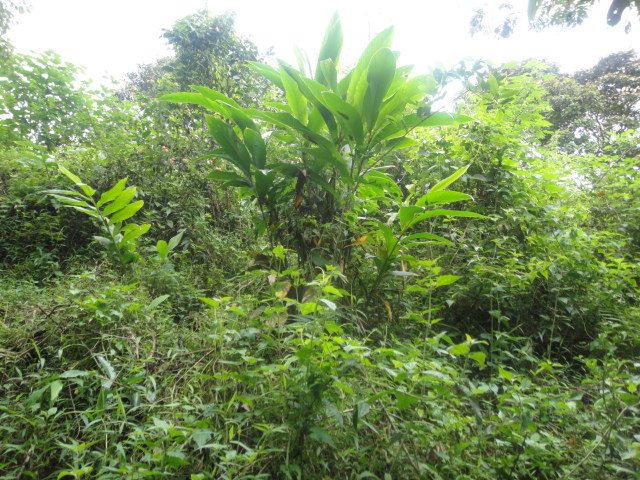
We walked along a ridge, then started to descend. Tangoma pointed out interesting plants that we passed. This one is elephant grass. It can be dried to make thatch.
Elephant grass


I didn’t realise pepper is a climbing plant.

Pepper

Here is wild ginger


This plant is cardamom


This is coffee. The beans won’t be ripe until about next April, by which time they will have turned red/brown. They are picked and dried for 8 days before roasting.

This is cocoa

I was left with the impression of all the valuable natural resources there are here. It was a bit like a visit to the Eden Project – but for real!

Shoe repairs


Waiting for the bus I realised that a make-shift hut had been made at one end of the shelter. It was about 2m square and made of polythene sheeting and plastic sacks tied together with string.  I could see a pair of feet sticking out at the front – the feet were wrapped in fairly clean white cotton rags. The bus arrived and I got on. For no explained reason the bus sat there for an hour before departing, so I was able to surreptitiously observe the man in the shack. He sat on a pile of sacks and was wearing a jacket, a knitted hat and glasses. He had a blue plastic sheet across his lap. He was carefully and slowly stitching a pair of old sandals.  I could see other sandals around him. One pair was placed just outside his shack and there were others visible inside on a shelf amongst newspapers and paper bags. When he had finished stitching he put the sandals away inside his shack, wiped his eyes with a handkerchief and blew his nose. This struck me as odd, as most people don’t seem to have a hanky; they sniff and spit, or blow their nose into the gutter.  He took a small purse out from inside his clothing and unzipped it. He took out his money nd counted it carefully. He separated some notes and rolled them up, then knotted them tightly into one end of a scarf. Next he took out a metal bowl and began eating from it. After that he just sat there, not looking out at anything in particular until the bus pulled away.

village house


My rickshaw driver took me to his village in the hills to visit his family.

Village street

He said it was his uncle’s house, but he introduced the man’s wife as his sister, so perhaps he just didn’t know the word for brother-in-law. I remembered from the muslim wedding that names of family members seemed to be interchangeable – one minute someone was a brother and the next an uncle.
The village was on the side of a hill, with rows of block built terrace houses with corrugated iron roofs. The village street was of swept earth.  Women put out washing and children played. There was a chicken with 6 tiny chicks pecking in the dirt.
Halfway down the first row of houses we came to the house we were visiting. We went inside and the couple greeted us with nods and smiles. They didn’t speak any English, so the rickshaw driver interpreted.

The people who lived in the house

There was a small entrance porch and then we were straight in the front room.  It was all very clean and tidy. There were two double beds, a sideboard display cabinet, a table and 1 chair. I was to sit in the chair while tea was made. There were cheery posters on the walls. Rugs covered the concrete floor. There was electric lighting.
Front room


The ceiling was covered in shiny patterned paper.
Ceiling paper


I was brought a cup of tea and a bowl of snacks. While I drank my tea they took a picture of the sideboard and showed me a picture of their two girls. They were dressed in matching school uniforms and looked to be about 12 and 14 years old. The man worked as the school bus driver and his wife picked tea. They were not working that day because of the Onam festival.
I was able to take a look around the rest of the house. Behind the front room was the kitchen. There was a bottle of gas for cooking.

The kitchen

Behind the kitchen was an attached shed made of wooden struts and sacking. It had a channel cut into the earth floor with water flowing. There was also a pipe and a tap for water. Tools and various things were stacked neatly on shelves in one corner.
The shed

A door in the back of the shed led to a small outside area cut into the hillside.
As we left and said goodbye the rickshaw driver gave them some money – presumably from my fare to him.
At the top of the village there was a hindu temple and a Christian church on the opposite side of the road. The ricksaw driver said that about half of the people who live in the village are Hindu and the other half Christian.
Temple and church

Tuesday, 13 September 2011

Around Munnar


I arrange for a rickshaw driver to take me into the countryside around Munnar. The route is a popular tourist one and I am keen to avoid most of the tourist traps. I particularly want to see the landscape, and visit a local view point called Top Station. I also want to see how people live and work. I ask him to drive slowly and carefully and not take me to any shops or places where I have to pay to have my photograph taken with a parrot. He seems to understand and agrees. We set off out of the town. We have only gone half a mile when he pulls into the forecourt of a shop.  Oh no, he hasn’t listened at all – this could be a disaster. But I’m totally wrong – he has stopped to answer is mobile phone. I thank him for his safety consciousness.

Rickshaw driver


We drive into tea plantation country. I didn’t know tea grew on such woody shrubs. The gaps between the shrubs make the hillsides look like they are covered in a huge maze. There are no tea-pickers to be seen, but I imagine them working there and trying to find their way out.

Tea plantation

Across the valley I can see some brightly coloured fabric laid out. I ask him what it is and he says it is clothes being washed. He parks up and we walk along a track in the plantation to a spot where stream collects before falling over a drop. 2 women are in the stream washing clothes. A girl of 8 is helping them and has been given the job of rubbings the smalls with soap against the rocks. An old lady is to one side laying the washed clothes on the ground to dry.
Laundry


We stop at the side of the road and he shows me bees nests high up in the trees. There is a honey seller sitting with his wares in bottles. He pours some onto my hand for me to taste. A pot in front of him is full of honey comb, still with some bees in it. He climbs up the trees and brings down the honey combs. The rickshaw driver says, ‘This man has many stings!’
Honey seller


Soon afterwards the driver forgets the original agreement and we stop at a place where I can have my photograph taken with a tea picking basket on my back. ‘No thank you, I particularly do not want to do that’. He looks a little sheepish. And then he redeems himself entirely by offering to take me to his village. I’ll tell you about that fantastic experience in a separate post.
After we leave the village, the road winds steeply and on a bend we pass a truck being loaded with logs. The trees are being felled and cut into logs. A group of men are working there. The trees also belong to the tea plantation and the wood is to be taken to the tea factory as fuel for the fires.
Logging
Driving on we come to a reservoir. There are stalls along the road on either side of the dam for the tourists who stop to look at the view. I get out and walk across the dam and several men ask me to pay for them to take my picture. They seem to be doing a reasonable trade with the Indian tourists.
Reservoir
We come to a part of the road where it is possible to see elephants in the wild. We drive slowly, but no luck. Perhaps on the way back.
The scenary is stunning and there are beautiful vistas at every turn. Where the valley bottoms are flat there is some vegetable cultivation and small stalls along the way are selling the produce.
Vegetable farming


At Top Station cars, rickshaws, 4x4s and motorbikes clog up the small access road and are left parked wherever the drivers fancy. It’s then a short walk along a ridge to the main viewing point. We are at the head of a valley with a ridge running to our right and the ground dropping steeply away below us. The plains of neighbouring Tamil Nadu are in the distance.  It was worth the drive.


View to Tamil Nadu


On the way back I remember to look out for the elephants, but it’s harder to see over the edge of the road because we are on the other side. We turn and corner and I catch a glimpse of something; perhaps it was a cow? I call to the driver; he pulls over and we get out. Coming up the hill away from the reservoir there is a family group of 3 elephants; mother, father and baby. They eat pull up the grass in the field and eat it or throw it over their backs. We watch them for about quarter of an hour before they disappear back down the hill.


Back in the bustle of Munnar I thank my driver and set off back to my guest house. All in all a very good day.