Sunday, 19 February 2012

The Catlins

I arrive back in Nelson on the bus from Kaikoura and meet up with Rory, who is the guy who has my van. She comes with the name of Josephine, a mattress in the back, a cooker and a cool box. He shows me everything I need to know and we agree that I will keep her for the next 3 months.
Josephine

As I have already spent 2 months in the north of the south island, my plan is to take a few days to drive right down to the south, while Josephine and I get used to each other. I park up overnight at basic camp grounds and stop in towns to buy the things I want to make the van more comfortable, including a pillow and spray to kill the sandflies.
I have arranged to meet up with a friend in Invercargill. Gordie (short for Gordon) is from Vancouver and we first met in the hostel in Nelson. We plan to travel together for few days to explore The Catlins, on the south east coast between Invercargill and Dunedin; an area which the Lonely Planet guide book describes as, ‘enchanting.’ It is a land of rolling green farmland, native forests, marine wildlife and rugged coastlines, reminiscent of north Cornwall.  I pick Gordie up from the airport, as he has just returned from Stewart Island and we drive out of Invercargill heading east. We arrive at Curio Bay, which is indeed an interesting and atmospheric place, set within a coastline very reminiscent of north Cornwall.
Curio Bay

In the bay, revealed at low tide, is a flat rock platform, which is the remains of a fossilised forest. As we walk across the rock and start to look closely we begin to see more and more remains of the 180 million year old forest. Tree stumps, fallen tree trunks and imprints of ferns are there to see.
Fossilised Tree Trunk and Tree Stumps 

The sea pounds against the lip of the rock ledge and the tendrils of enormous kelp plants are constantly dragged and swirled back and forth in the gullies.
Kelp

The bay is also home to a small protected colony of 8 breeding pairs of rare yellow-eyed penguins. They have their nests in the bushes at the back of the rock beach and the young penguins wait there patiently all day, while the parents swim out to sea to fish.
Young Yellow-Eyed Penguins

In the evening the Department of conservation warden clears the tourists to the side of the beach, to allow the returning adult penguins uninterrupted access to their nests. The young penguins start to get excited and jump off their rocks and waddle clumsily towards the edge of the sea to meet the returning adults.
Watching the Penguins

There is a camp ground right on the isthmus between Curio Bay and Porpoise Bay, with tents and camper vans nestled amongst the flax. We park Josephine up overlooking the bay and as we settle down for the night we will discreetly close the curtains in the van and leave the rest to your imagination.
Curio Bay Camp Ground

Gordie

The next day, after watching a pod of Hector’s dolphins playing in the swell off the headland, we drive on and make several short sight-seeing stops along the way. This route is firmly on the tourist map and over the day we keep bumping into the same groups of people who are doing the same stops as us. First up is a short walk through cool rainforest to a beautiful waterfall.
McLean Falls

Next stop is a boardwalk across an area of saltmarsh in the Tautuku estuary.
Saltmarsh

Then we visit the Cathedral Caves, which are only accessible 2 hours either side of low tide by walking along a beautiful white sand beach of Tautuku. Even at low tide we are surprised by the occasional surprisingly powerful wave that gets us wet up to our knees and makes other sightsee-ers cling to the cliffs.
Cathedral Caves


A little further along the coast road we stop at a lookout over the beautiful bay.
Me at Tautuku Bay Lookout

Tonight’s camping ground is up 11km of gravel road, alongside the Catlins River and the following day we take a 5 hour walk that heads upstream; crossing swing bridges and stopping for a rest at a natural weir.
Catlins River Walk
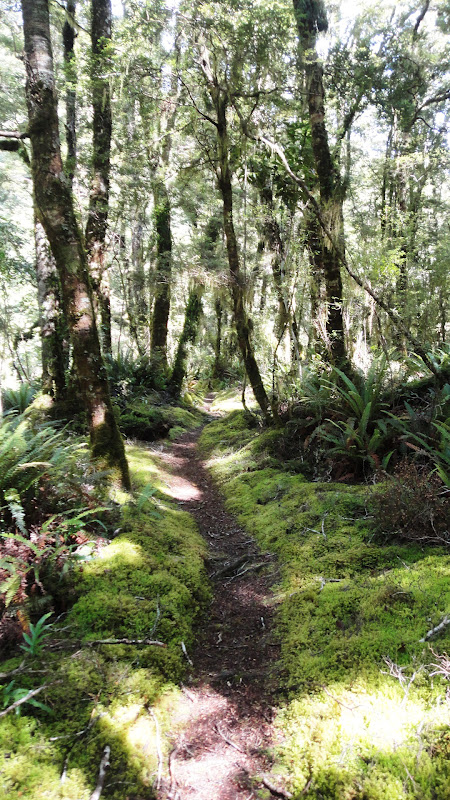

In this bush there are rare yellowhead birds and we see a small flock in the trees, but they are too small and well-camouflaged to photograph.
Tonight we camp right by the side of the estuary at a little seaside place called Pounawea.
Estuary at Pounawea

The next day we go a little further along the coast and walk along the beaches at Cannibal Bay and Surat Bay hoping to see sea lions. We are not disappointed. Some sleep on the beach, singly or in pairs and shovel sand over their backs with their flippers to keep themselves cool.  Others frolick in the surf, or gather in small groups at the edge of the water and bark at each other.
Sea Lions


Walking along these beaches I am momentarily confused about where in the world I am. Is this New Zealand, or North Cornwall?
New Zealand or Cornwall?

We drive on and camp at the small, rather charmless seaside settlement of Kaka Point. The small shop looks as if it on the point of closing down and has a strange collection of things we don’t want to buy, on half-empty shelves. The most interesting thing we find in the place is a poster in the shop window for the ‘Open Critter Hunt’ which advertises itself as a day of family fun with wood chopping and possum-skinning. Yeah right – roll up with your small children and we’ll give you an axe and a sharp knife and see what fun you have!
Open Critter Hunt
The next morning it is raining and we drive out to Nugget Point where there is a short walk to a lighthouse. There are high cliffs here and the headland demarks a change in the character of the sea. To the south east the sea is rough, with rolling breakers and to the north west it is calm and still.
Nugget Point


We start our return journey back towards Invercargill via the inland main road and stop in the town of Gore, where there happens to be a vintage car rally. We spend an hour or so strolling around looking at the cars and reminiscing about cars of our youth – Gordie with the Cadillacs and me with the Fords. There is also a Singer Gazelle, which I think is the car that my friend Lindsey had while we were at college and which she shipped out to the USA when she moved there after college. The car was called Mabel and she had to sit with cushions behind and underneath her to be able to sea over the steering wheel and reach the pedals.
Vintage Car Rally

Singer Gazelle

Tonight is the last of this trip and we camp in a country park outside the town. In the morning when it has stopped raining we walk up to a lookout before parting company in Gore. I will be going to do some walking on Stewart Island and Gordie is going to walk the Milford Track. It has been a lovely 5 days and has felt like a holiday outside of our respective travels. We have no specific plans to meet up again; but it is a possibility. Let's see.
Me and Gordie at Dolamore Park




Sunday, 12 February 2012

Kaikoura and Hanmer Springs

Sarah (my roommate) and I travel together by train for the 2 ½ hour journey from Picton to Kaikoura, which is on the east coast. New Zealand only has a few passenger lines – one in the north island running down its length and two in the south island; one going east to west across the mountains via Arthur’s Pass and the line we are taking, which runs down the east coast from Picton to Christchurch. There are smart new carriages and the windows in the two passenger carriages are big to make the most of the scenery. There is one open-sided observation car and a smart refreshment car. After the conductor has checked tickets, he comes around again selling ice-creams. Is this a train or a cinema?

Kiwi Rail

Sarah on the train

As the passengers get on and settle into their seats I recognise a girl who was on the wine tour yesterday. This is Sally, who comes from Yorkshire, but has been working in the north island for a couple of years and now she is travelling in the south island before going back home. She joins me and Sarah and as we chat we discover that she is booked into the same hostel as us in Kaikoura. Now we are 3.
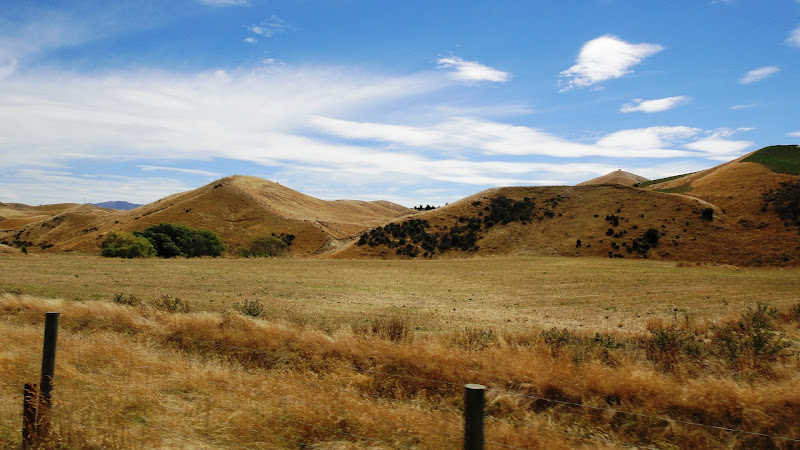
To begin with the train travels through the Marlborough wine region that I visited yesterday and then it goes through hills covered with dry yellowy-brown grass. In one field there are lamas and deer in another.
Inland Scenery

After a while the line heads towards the coast and soon we are running parallel to the road right along behind the beach.
Coastal Scenery

As we near Kaikoura we start to see fur seals on the rocks. They are quite hard to spot at first, as they blend in so well with the rocks. They are now protected and their numbers are increasing.

 As the 3 of us sign in at the hostel we meet another girl we recognise from the train - Erica from New York. Now we are 4. We decide to take a walk in the early evening through the town and around the peninsula. It is lovely to see the mountains so close to the sea. A couple of peaks in this range are over 2000m.
Mountains by the sea

Erica, Sally and Sarah

The walk is along a pleasant grassy sward with open views in all directions. On the far side of the peninsula the cliffs turn white and the scenery is rather like along the Dorset coast.
White Cliffs

The next day it is raining and Sally leaves us to continue her journey. Erica, Sarah and I hire a car and drive to Hanmer Springs, where there are natural hot pools. The little town has a tree-lined main street and some upmarket shops and cafes. This could be a European spa town and because of the look of the place and the multi-national company I am in, for a moment I have the feeling that I don’t quite know where I am. We have a pleasant soak in the various pools and feel very relaxed. A nice way to spend a gloomy day.
Hot Pools at Hanmer Springs

We say goodbye to Sarah here, as she will be staying here for a few days. She is nearly at the end of her trip and will soon be returning to Switzerland to start her career as a vet. She has been lovely company for the last week.
I have finally heard that my van will be ready tomorrow, so my plan is to catch a bus back to Nelson to collect it and then take a few days to drive the 1000km or so, right to the bottom of the island via the west coast. I have really enjoyed my stay in the north of the south island, but I am excited to finally be moving south.

Wednesday, 8 February 2012

Picton

Picton is a small town at the head of Queen Charlotte Sound. It is the place that the ferries between the north and south islands come into. For many people it is just a place to transit through, but it is a nice little place in its own right.
Picton water front
I am staying at a hostel called The Jugglers’ Rest and when I get here I discover that this is not just its name, it’s also describes its function. Jugglers and other performers stay here on-route to various festivals. Unfortunately at the moment all the good jugglers are away at a local festival and meanwhile the backpackers staying here have a go with the various items of juggling equipment that are available and I polish up my 3-ball juggling skill.
Jugglers’ Rest – Phillip with juggling balls and Sarah with Poi

In the afternoon I take a short walk out to the headland where there are fabulous views of Queen Charlotte Sound.
Me and Queen Charlotte Sound

On Monday it is Waitangi Day, which is a public holiday to mark the signing of the Treaty of Waitangi between the British and Maori in 1840. The treaty caused some confusion right from the start, as translation issues meant that the version written in the Maori language differed from the English one in small, but significant details. In the north island this day often involves controversy as the Maori tackle the Prime Minister on ancient and recent issues, but in the south island the day is more about unity and inclusivity. I find out that there is to be an event at the local Maori Marae (meeting place) and as I have not been able to absorb much in the way of Maori culture on this trip so far, I go along with Sarah, my lovely Swiss roommate from the hostel. We turn up just before 10 in the morning and we are greeted in the entrance gateway by a friendly Maori representative, who explains to us and the other visitors what will happen. There will be a ceremony for us to be welcomed onto the Marae by the elders of the tribe. We arrange ourselves in a group, with the women and children flanked by the men and when we are called in, we walk like this into the compound. We have to take our shoes off before going into the meeting house and then we file past a row of 6 elders and touch noses and shake hands with them. We sit in rows of chairs, facing the elders and a group of young people wearing traditional dress. One of the elders starts the proceedings by making a long speech in Maori and then one of the visitors responds by saying how happy we are to be here and to share this important day with them. Then there is some singing and challenges which include face-pulling, to check out whether we are friends or foe and a sung response from us to reassure them we are friendly. After the ceremony, one of the elders gives us a tour of the house, pointing out the symbolism of the construction and explaining some of the characters depicted in the carvings on the walls. One wall depicts characters from their tribal history and the opposite wall has images from outside the tribe, including Abel Tasman and James Cook. Unfortunately we were not allowed to take pictures inside the house, but here is a picture of the front of building.
Marae

Now the formal part of the day is over the rest of the programme is more like a fun day, with a barbecue, bouncy castle, baby show and egg and spoon race. There are also a couple of Maori performances of singing and dancing, which are very enjoyable. The women sing sweetly and melodiously, swinging their skirts and making gestures. The men join in too, but add an interesting bass line by occasionally beating their chests, issuing harrumphs and pulling faces, haka-style.
Performance groups


I decide to experience the Marlborough Sounds from the water and arrange to do a day’s sea kayaking on Tuesday. Our guide is a Kiwi called Marius and then there are 4 of us: me and Jacob from Austria in one kayak and Alex and Elizabeth from Germany in another. We set off from a beach just west of Picton.
Preparing to Kayak

The day is overcast and the clouds make the Sounds very atmospheric. The constantly changing light alters the colour of the water from turquoise, to green, to black. We paddle for a couple of hours along the coast and then across the Sound to a small beach, for a picnic lunch. In the afternoon Jacob leaves us to walk on the Queen Charlotte Track, so I go in a kayak with Marius.
Me

As we paddle, the wind gets up and we keep to the shore line where we can, for shelter. We get to a point that we have to paddle around to get back to Picton and we can see the wind blowing the sea into waves in front of us. We round the point and paddle directly into the wind, with the waves splashing over the front of the kayak and the rain in our faces. I am glad to have Marius in my kayak with me. The other two are struggling to make headway, so Marius attaches a line to their canoe and we go along together. We take some shelter and a rest behind a small island before tackling the last stretch to Picton beach.  By the time we get to the waterfront the wind has dropped and the rain has stopped. It was a great day and the changeable weather made it an interesting and varied experience and enough of a challenge for us to feel pleased with our achievement.
Made it!

The other experience I feel I should have while I am in this Marlborough region, is a wine tour, so I arrange this for Wednesday afternoon. I get picked up from the backpackers in a small coach and join a group of 8 others. We are taken the short drive to the Wairau Valley which is the heart of wine region. The vineyards are planted on stony riverbed soil, which the vines seem to like and the region has long sunny days, but not excessive heat which suits the production of the grapes.
Marlborough Region Vineyards

We visit 4 different vineyards, each with a very different atmosphere. One is a big corporation and another is a small family business. We get some information about viticulture, but it’s really all about tasting the wines.
Forest Vineyard Cellar Door

Sauvignon Blanc is the original grape variety of this area and more recently Pinot Gris (which is the New Zealand version of Pinot Grigiot) has been developed. We also try Chardonnays, Rieslings and red wines such as Pinot Noir and Syrah (which is the New Zealand version of Shiraz). For each tasting we get a small amount – just a couple of sips, but we try about 4 wines in each place and soon one wine begins to taste like another. I guess it’s a bit like trying perfume – after two sniffs you can’t differentiate any more. I’m not overly excited about the whole thing. I'm not too bothered about the intricacies of the different smells and flavours; I just like the wines I like and I realise that I should be more discerning in making my choices about what I do. Just because something is on offer, or other people have done it and enjoyed it, doesn’t mean that I should do it.

Friday, 3 February 2012

Havelock and The Queen Charlotte Track

I catch an intercity bus one hour east of Nelson and arrive at the little town of Havelock, which is situated on the west of the Malborough Sounds, at the mouth of the Pelorus River. Havelock calls itself ‘The Greenshell Mussell Capital of the World’.
Havelock

I make a circuit of the town and find it has a pleasant waterfront with a working harbour for the mussels and a smart marina. There are several places to eat, from a takeaway to a top end café-restaurant and they all serve mussels. I decide that I should try the mussels while I am here and as I have a discount voucher from the hostel for the posh café-restaurant, that’s where I have my lunch, sitting looking out over the marina.
Havelock Marina
Mussells for Lunch

I call into the small museum and find out that there was an original Maori settlement on this site and then the European settlers came here on the back of the gold rush of the 1860s and Havelock grew up as a port to service this industry. Timber and saw mills were the main business and the museum has many mementoes of this time. One of the main sources of entertainment and recreation in the town seems to have been wood chopping and sawing competitons.
Sawmill workers of 1880

I am amused by the collection of saws displayed on the wall of the museum – it’s a family joke that Sue, Keith and Andrew will appreciate!
Saws in the museum

Havelock has two famous sons: William Pickering, whose field of expertise was jet propulsion and guided missiles. He directed the construction of the first US satellite. The second was Ernest Rutherford, who won a Nobel Prize in chemistry in 1908 with the snappy title of ‘his investigations into the disintegration of the elements and the chemistry of radioactive substances’. He was one clever dude and developed the fore-runner of the Geiger Counter and split the atom in 1918.
I look in a shop window that displays community notices and posters, to see what is going on in the town. Sadly there don't appear to be any woodchopping competitions any more. There is an advert for the Havelock Players amateur dramatic show which is currently running at the community hall. The proceeds from tonight’s performance are going to the Christchurch earthquake relief fund. There is also a poster still up from last year’s Annual Havelock Pig Hunt. It took place between 6am on Friday 17 June, with the final weigh in at 4pm on Sunday 19 June. The prize for the ‘best tusks’ is a taxidermy freeze-dried head mount valued at $1000 (about £500). The heaviest boar prize is $500 worth of jacket and trousers. There are also separate women’s and youth categories for under 15 year olds. The youth’s first prize is a hunting knife worth $200 and the women’s first prize is a voucher worth $150. Not much encouragement for the female hunters!
Annual Havelock Pig Hunt Poster

I borrow a bicycle from the hostel and cycle out along the side of the estuary to a point. There is a short walkway here which gives great views of Pelorus Sound.
Pelorus Sound
The Queen Charlotte Track is another New Zealand ‘Great Walk’ it goes through the Malborough Sounds and it finishes not too far from Havelock. The walk is very flexible, like the Abel Tasman Coastal Track, in that you can get water taxis to various points along the track, have your luggage transferred and also kayak or cycle. The down-side of the track is that it can all get quite expensive. Much of the track is on private land, so there is a track fee to pay and all the accommodation is private.  I decide I will just walk the final section of around 25km as a day walk. I decide to hitch to get to where I want to start walking and back from the finish. Before people back home start getting worried, let me explain that many backpackers use hitching to get around New Zealand and everyone I have spoken to says that it is nothing like hitching in Europe and they have only had good experiences. It is also a good way to meet New Zealand people. I haven’t done it myself yet, but I take the advice of the hostel owner that it is the best way to access this part of the track. So here comes another new experience for me. The day is overcast, and slightly chilly, but dry. I set off at 8 o’clock, eager to get an early start and walk down the road and position myself appropriately on the quiet road that heads in the right direction. I soon realise that I am probably too early, as the first vehicles that go past me are people going to work and they shrug and wave at me, but don’t stop. After about 20 minutes a travelling salesman on his way to Picton picks me up. He sells Unilever food products to school kitchens and residential homes. After about 20 minutes he has to drop me at a T junction because our paths diverge. Again I stand by the side of the road with nothing in sight other thn a few cows in a field. The first car that comes past stops. This is an English ex-pat woman who has been living here for 5 years. She takes me another 15 minutes to a lay-by, where she turns off down a small ‘no exit’ road. It is very quiet here, with very little traffic and I can hear the few cars there on the road approaching before I see them. The first few vehicles just drive on by, including a small black sports car, which is really motoring. I’m glad he didn’t stop. Next up is a huge lorry with two trailers. He pulls up and is happy to take me the final ½ hour to my destination. He works for company that has the contract to maintain the roads in this remote area and he is taking a load of gravel in to resurface an unsealed road and then he is bringing out a digger. As we chat I ask him if he usually picks up hitch hikers. He answers no, because it is against company policy, but he stopped for me because I was standing in such a remote location, he didn’t think I would get a lift otherwise. The road winds around the coast, with beautiful views of the sound. He stops talking whenever we get to a particularly difficult section of the road. Often he needs the whole width of the road to negotiate the corners and even then in the mirror I can see his back wheels right on the white line at the edge of the road. He drops me at a small bay called Portage where there is a smart hotel and a few houses. It is 10 o’clock and I am pleased with my first hitching experience. I start my walk by climbing up a steep tarmac road to join the Queen Charlotte Track, which runs along a ridge between Kenepura and Queen Charlotte Sounds. There are beautiful views from the track in both directions. On a sunnier day the sounds would probably be even more stunning.
Queen Charlotte Track along the Ridge
Views from the Track


Along the way there are small foxgloves by the side of the path and at one point where the tracks drops down to a cove there is a whole bank of blue and white agapanthus planted outside a property.
Foxgloves

Agapanthus

The walk takes me 6 ½ hours and it is pleasant to trot along carrying only a day bag. When I get to the car park at the end of the track I start walking along the road and stick my thumb out to the first car that passes. It stops and in it are a couple of young Danish girls who I passed and re-passed on the last part of the path. They drop me right back to my hostel and I am back by 5pm.