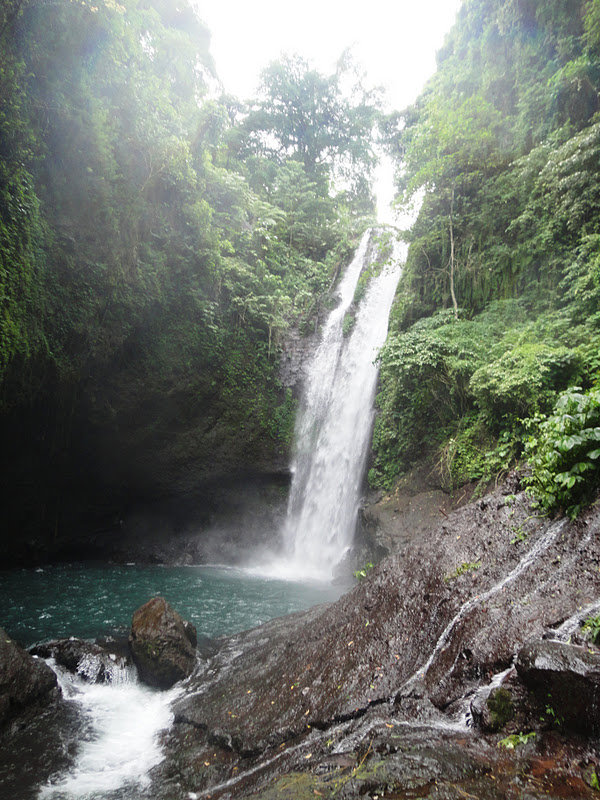
Friday, 16 December 2011

Gili Air

So it’s my last 4 days in Asia and I choose to spend them on the Gili Islands – 3 little islands close to Lombok. It is an hour’s fast boat trip from Amed. The Lonely Planet guide book describes them like this, ‘Picture three miniscule desert islands, fringed by white-sand beaches and coconut palms, sitting in a tranquil turquoise sea’. There is no motorised transport on all 3 islands; only bicycles and small horse-and-carts. Trawangan is the biggest of the three and has a renowned party scene; then there is Gili Air, which the guide book says has ‘the strongest local character and a mellow atmosphere’ and lastly Gili Meno, which is the smallest. I decide to base myself on the Goldilocks island - not too big, not too mall, but just right.
Leaving Amed

The boat stops first at Trewangan to drop off some passengers and then we wait to pick up some others and then make the short crossing to Gili Air.
Boats on Gili Trawangan

I walk along the coast from the harbour via the sandy track that goes between beach front bars (advertising happy hours, cocktails and magic mushrooms!) to choose where I will stay. The path has hoof-print down the middle from the mall horses that pull the carts.
Path between the beach bars
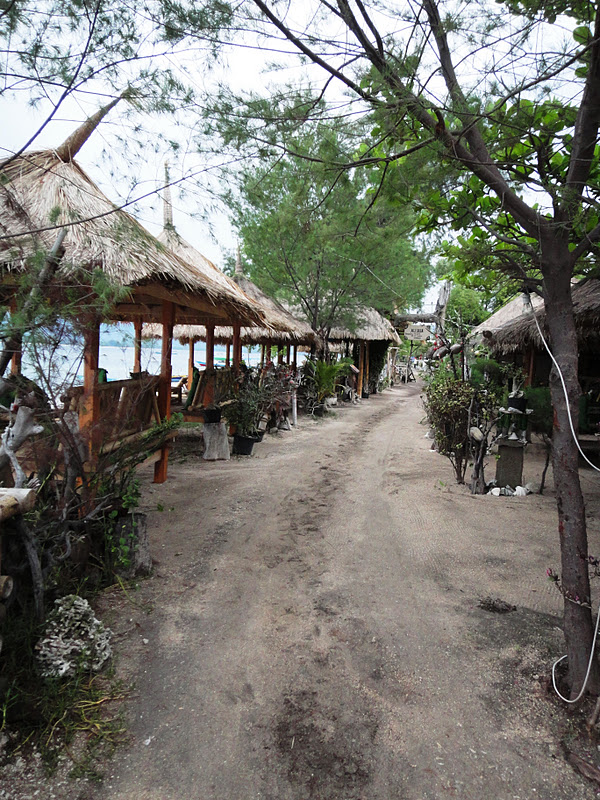
Horse and cart


The island instantly has a different vibe about it from Bali – because it is Muslim, rather than Hindu there are no 'offerings' going on. Within an hour I have found a cheap bungalow, just back from the beach; been offered the opportunity to smoke dope on the beach twice and sex once! Yes, apparently even an old bird like me can get laid here. The local men are not averse to getting in on with an older tourist – maybe they think of it as charity work; or perhaps a possible investment in a better future, gigolo-style. Anyway I politely decline, ‘No thanks, I’m not looking for a man’. ‘She say that before,’ he says moodily, ‘but then in two days I see her kissing with my friend.’ Some of the Indonesian men are very cute, with smooth dark skin, dark eyes and beautiful white smiling teeth; but this one has unfortunately bad dentures!
My bungalow is very rustic, with a creaking plank floor and a hammock on the veranda.
My room

The island has a very intermittent electricity supply and it’s salt water in the shower, which is a rather unsatisfying experience, as you come out almost as sticky as you went in. While it rains gently I sit under-cover by the beach and read some more of ‘Eat, Pray, Love’. I’ve got as far as the third part and it seems appropriate to finish it, while I am still in Indonesia. I’m enjoying it very much and occasionally I laugh out loud. If you haven’t read it, I recommend it to you.
Once the rain stops I take a walk around the island, which only takes an hour to get all the way round. You set off, saying hello to other tourists walking the circuit in the other direction and before you know it you meet them again, ‘Oh, hello again, didn’t I just see you before?’ It’s a sandy track all the way, or you can walk directly on the beach. There are views across to Lombok and then later to Gili Trawangan.
Sandy track

Walking on the beach
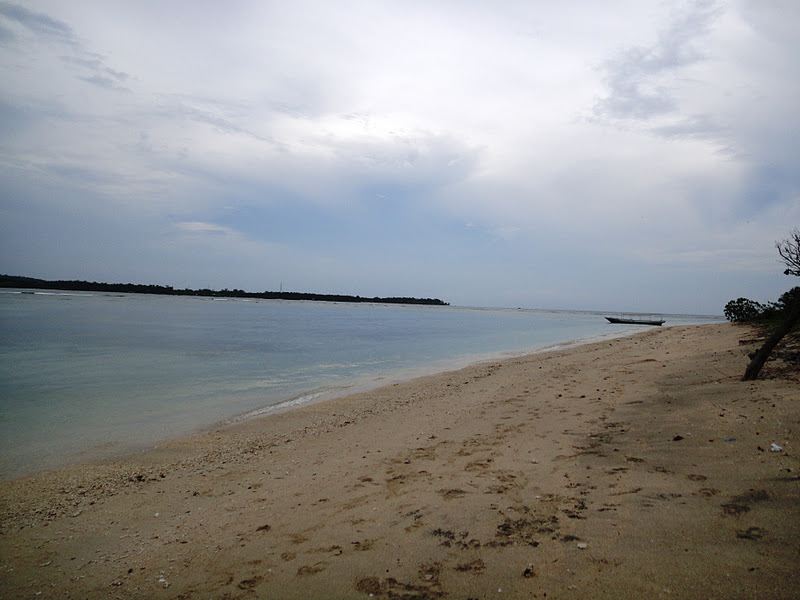
Looking towards Lombok

Some parts of the beach are covered in drifts of dead coral, looking eerily like skulls and bones, which crack under your feet as you walk.
Driftwood and coral sculpture

I decide that I will have a go at diving while I am here. It seems a good opportunity while I have 3 spare days and a beautiful warm clear ocean. This is a challenge for me, as I have always had a fear of not being able to breathe under water, even though I am a good swimmer and love being in the water. I find myself inadvertently holding my breath and gasping for air when I watch something on the television or a film with a scene under water. I think ‘Journey to the bottom of the sea’ did it for me when I was a child – that old television series about a submarine and then I was never comfortable watching Jacques Cousteau – all that sound of breathing air in and bubbles coming out. Anyway, I overcame my fear of heights by learning to climb, so maybe it’s time to face this fear too. Also I have just met two separate people in the last few days who have just learned to dive here and raved about this being their new best thing. There are several dive schools on the island, so I go along and have a chat and before I know it I’ve signed up for an introductory session tomorrow and if I like it I can continue with a full course. My tutor is a little Mexican guy called Yanil. He is very reassuring.  I come back to my bungalow clutching a manual to read for homework.
The next day I go along and to begin with a have to watch 2 videos and complete some written question and answers. It’s quite complicated about pressure and equipment. Then it’s time to go into the pool. He shows me the equipment for real and how to attach this gauge to this pipe and check the air cylinder etc. Then the whole thing goes on my back and it’s incredibly heavy – even heavier than my fully-loaded rucksack. We get into the shallow end of the pool and I practice breathing underwater. It’s very strange to hear your breathing in your head; but it works! I have to do various exercises like take the regulator out of my mouth and replace it, how to clear my mask of water and how we can share air in an emergency.  Then we go down to the deep end of the pool and practice equalising the pressure in my ears and letting air in and out of my jacket to be able to swim under the water at the right depth. It is all very strange to only be able to communicate with signs, but he shows me what to do and I copy.
Then I take off my air tank and a girl called Charlie, from Tunbridge Wells teaches me some skin diving and snorkelling skills – how to duck dive and then clear my snorkel of water and how to breathe past some water in the snorkel.
After a lunch break it is time to go out into the ocean. Several other experienced divers join the group to do their own dive and we take a short boat ride out to the dive site.
Yanil my diving instructor

Boat trip to the dive site

Then I have to get into the water with all my kit on by doing that falling-backwards-off-the-boat thing that divers do. Yanil and Charlie are with me and we snorkel over to a buoy – the depth of the water is scary, it’s like a fear of heights, although we are only going to about 10m. We descend on a rope and spend about 20 minutes swimming around. The fish and coral are amazing, but I can’t really appreciate them because I am concentrating so hard on what I am doing. I’m quite glad when it’s time to resurface and the dive is over.
Me as a diver!

Yanil asks me if I enjoyed it. I reply that I don’t think I did, but I do feel a sense of achievement. Back on land I feel quite emotional and strangely disorientated. As I walk back along the track to my bungalow, I don’t quite recognise things, although I’m sure I have been to a place a bit like this before. While I have been underwater someone has dismantled Gili Air, lost the original plan and rebuilt it from memory, so that not everything is in quite the right place or order. I’m quite glad to get back to my room and find it is still there, but inside looks different too, even my own things don’t look quite as I left them. I take a rest in the hammock on the veranda and gradually everything normalises, as if things are coming back into focus. I don’t think I’m ready to do the full open water course yet; I need time to assimilate the experience. Maybe I’ll come back to it another time. Just now I need food and beer.

Thursday, 15 December 2011

Amed

Kadek picks me up again from Munduk and drives me east along the coast - back to the heat. As we drive along I ask him more questions about Balinese culture and he is very good at explaining; even though as he says Balinese Hinduism is very complicated. We talk about death, karma, reincarnation, animism, filial and parental responsibility, government corruption – all manner of light-hearted topics really.
We arrive in a small place called Amed, which is a collection of small fishing villages strung out along the coast on the eastern cape of Bali. The landscape is more arid here – more Mediterranean. People come here for diving and snorkelling and also because it is a good place to get to the Gili Islands, which is my next destination. I book into a guest house and get a lovely bungalow just across the road from the beach. I am lucky to be here in the low season, because accommodation is relatively cheap. Normally by this time of year the tourists are flocking in, but this year, wherever I have been on Bali the locals are saying it is unusually quiet. It makes me realise that the financial situation in the west is having a very far-reaching impact.
My room

In the relative cool of the late afternoon I walk out onto the headland and take in the view of the village. Then I walk back along the beach and watch local boys swimming and playing in the sea. They swim out to a moored fishing boat and clamber over it and push each other off it, in the way boys do.
Amed

Boys playing in the sea

The fishermen go out in their boats in th early morning, before it is light. When they come back, it takes four men to haul the boat up onto the beach.
Hauling in a boat

There is a type of selling on the beach here that is new to me so far. Children of between 8-10 years old wander up to me and ask me where I am from; how long I am staying and what my name is. They each have a notebook in which is written something along the lines of, ‘These children are selling locally-made items to help pay for their education. They have been weaving baskets in school. Anything you buy will help pay for books and other necessary items.’ I buy a small wooden boat in the style of the traditional fishing boats from a girl. It comes in pieces, so I hope I will be able to get it to New Zealand safely and then send it back for Megan and Elliot. I take a photograph of her with a real boat on the beach, so Kate will know how to put it together. While I am talking to the girl another two boys see that there is a sale being made and hurry over. One is particularly pushy and thrusts necklaces at me saying, ‘You buy from me’. He gets sulky and cross when I tell him I’m not buying anything more.  He mutters a curse, ‘Your boat will break’, he says. Top of the class for use of English and intimidation, but bottom of the class for manners and sales technique – but he might be right.
Girl and fishing boat

As it gets dark I sit in the restaurant overlooking the beach and eat dinner and drink beer. I chat to Made who works here. He is eighteen and left school 2 years ago. He has a girlfriend who is 16 and a dancer, but they hardly see each other because he is usually working. Later a blood-red gibbous moon rises from the sea.

Munduk

I arrange for a driver to take me into the hills to stay in a small village called Munduk. This is about an hour’s drive inland and during that time we climb from sea level to over 1000m. My driver, Kadek, has excellent English and we chat as we go along. He was brought up in the hills in a village called Tajun, but he didn’t like the cold  and couldn’t sleep at night (we are talking about the temperature dropping to maybe 15 degrees at night), so when he was old enough he left the family home and went to live by the coast where it is hotter. He met his wife there and stayed and now he can sleep! We talked about tourism on Bali and he says it is very important as 75% of people work in tourism. I asked whether tourism has changed people’s outlook in any way and he said only that it brings some prosperity. He said that Balinese people are generally happy with their lot, even though most have a hard life. It is not in the Balinese culture to travel, so people don’t generally wish that they too could travel and neither do they wish they could live like western people. He said that they accept Western culture, take what they want from it and discard the rest. For example they see Western people swimming in swimming pools and watch it with mild interest, but they don’t want to do it themselves.
As we climb into the hills we drive through a village that Kadek says is the most prosperous in the whole of Bali. The houses here certainly look more substantial. The wealth comes from coffee and he says that most high ranking officials and government officers come from this village, because the prosperity means that the children have better schooling and therefore better opportunities.
We arrive in the village of Munduk, which is strung out along the road and there are distant views of the coast. I book into my accommodation. It definitely feels cooler here and there is no fan in my room; hopefully because it isn’t necessary. The shutters are open to a fantastic view of rice fields, plantations and distant hills. Perhaps I will be able to sleep better here in the cooler air.

View from my window

Centre of Munduk village


In the afternoon I take a walk through the village and then along a track through the forest (I learn later that this is in fact plantation) to visit a local waterfallIt is a beautiful spot with a rustic café nearby.

Track to the waterfall


Waterfall


I am the only customer in the café. On the recommendation of the café owner I order ‘Lak Lak’. This is a sweet dish of small sticky rice flour cakes, topped with syrup and grated coconut. As I eat them slowly while gazing at the waterfall, some music starts playing. First of all I assume the owner has put on a CD, but when I look round he is sitting on the floor playing a traditional bamboo xylophone. It takes me a while to place the tune and then I realise it is ‘Old Lang Syne’! Truly a surreal moment.
Bamboo xylophone


The next day I have arranged to go for a trek in the local area. My guide is Putu, a 29 year old local man. He has excellent English and is obviously proud of where he lives and is keen to share his knowledge of the area and Balinese culture with me. First of all we walk down the main street and he points out an old house left over from Dutch colonisation. Then we visit the village market. Putu says the stalls begin to be set up at 3 or 4 o’clock in the morning and they carry on trading until about 11 o’clock or when they have sold their produce.
Dutch colonial house


Market


I have noticed that many Balinese people seem to have the same names as each other and I ask Putu to explain. He says that children are named by their position in the family. The first-born child will be called Wayan, Gede or Putu; the second-born, Made, Kadek or Nengah; the third born, Nyoman or Komang and the fourth-born, Ketut. If there are more than 4 children, they go back to the start of the list. That system would put a lot of baby name book compilers out of a job in the west; but it could save a lot of arguments and heart ache as couples would no longer need to debate whether they ought to call their precious offspring after Uncle Horatio.

Then we set out into the rice fields and through plantations. What looks initially to me like rain forest is in fact cultivated with many varied plants; for example at any point along the side of the path there might be clove trees, bananas, nutmeg, coffee, guava, avocado and pineapples all growing alongside and underneath each other. Even the bamboo is planted, so that it can be used for making irrigation channels, building and also to keep the water in the soil in the dry season. The rice terraces are beautiful and the rice harvest is finished in most fields, but we come across one area where they are still at work cutting the rice and threshing.

Rice terraces surrounded by plantations

Rice threshing


When the rice has been harvested the terraces are flooded and are ploughed while flooded.

Fallow rice terraces

Ploughing with cows
Meanwhile the new rice plants are growing in nursery beds, ready for the next planting.

Nursery beds of rice


The small houses in the fields are not where the families live full-time. They have houses in the village, but these places are just where they can rest and cook etc while they are working in the fields. I ask Putu why they don’t live on their land and he said that the land is designated for agriculture, so no permanent buildings are allowed to be built here and anyway the people choose to live together in the village where there are the necessary facilities of shops etc. and community life.

Cow shed

Women carrying rice


We stop in one field which belongs to Putu’s brother and wife. Here the rice is being dried and has to be turned over several times.
Drying the rice

In another field he points out his mother. She is 67 and retired, but still likes to come and work in the rice fields. She is raking the rice to turn it as it dries.  I ask if I can meet her. She doesn’t speak English, but she is friendly and smiles broadly, as all Balinese do. Her teeth are all over the place. She is wearing an old cotton shirt that is fastened at the chest with a safety pin, revealing her breasts.  Through Putu she asks if I would like some coconut. Putu said he climbed a tree yesterday to pick some nuts and there is one left. She goes to fetch it and moves nimbly through the field. The Putu cuts the top off the nut with a machete and pours out the coconut milk. The nuts gives 3 big glasses of almost clear liquid that tastes fresh and delicious and not like any coconut milk that I have had from a nut at home. Then Putu cuts out some of the coconut flesh and it is soft and sweet. He talks about family life. It is important to have sons because they stay and support the family, whereas girls will go and live with their husband’s family when they get married. Each child in the family is given a role, as decided by the parents e.g. who will look after the parents, who is responsible for financial matters etc. and the children accept these role. 
Cutting the coconut
Putu and his mother

We leave the rice fields and walk through more plantation and then start to climb steeply up hill. We come to a spring, which is a holy place and Putu makes an offering here to the spring with a small palm leaf saucer filled with flowers, a couple of incense sticks and a coin. He asks me if I would like to pray too and when I say yes, he gives me a scarf to tie around my waist and we each take a flower from the offering and hold it in our hands as we make our wishes or prayers. Then we put the flower behind our right ears.
Holy spring


As we continue on we meet two small boys on their way home from school. They generally go to school from 6 or 7 o’clock until 11 o’clock. They look cheeky in their school uniforms and pose for their photograph. I don’t think they meant to make rude gestures – they were just posing.
School boys walking home


We look out across the valley back towards Munduk village on the ridge and can see rain heading our way.
Rain on the way

Our next stop is to visit the banyan tree and we hurry to get there before the rain really starts. Putu explains that banyan trees are very rare and this one is sacred and is where 350 patriot soldiers hid from the Japanese during the occupation of Bali in the 2nd world war. I ask him if the tree is protected as it is so special and he answers, ‘Yes, by the spirits’. I guess with that sort of protection, government protection isn’t required. We get there just as the rain starts. There is a barn-type structure here that is used for local meetings and events, so we shelter there and have our lunch. The banyan tree is enormous and next to it are two temples; one is to the spirit of the banyan tree and the other is to… I forget what.
Banyan tree

Next to the tree is a sign which says, ‘The women during menstruating period is forbidden to enter.
No menstruating women may enter

I ask Putu about why this is and he says that menstrual blood is not healthy for the spirits. A menstruating woman is also not allowed to enter a temple.
Putu makes another offering here and we pray again. Then, as te sign doesn't apply to me, we go round through the Banyan tree temple and can walk inside the tree between the roots and trunks. Inside it is enormous and has spaces that you can walk through or clamber up into. I can now see how 350 soldiers could hide in here. Bali declared its independence from the Dutch and Japanese on 15 August 1945, immediately after the Japanese surrender, although the Dutch didn’t recognise this until 4 years later, but this is the date the Balinese celebrate as Independence Day each year.

Inside the Banyan tree

As we leave the banyan tree it is now raining heavily and for the first time since I was in China (which was about 6 weeks ago) I put on my rain coat – not because it hasn’t rained since then, but because when it has rained, it has generally been too hot to wear a coat and an umbrella has been a better option. Putu decides that we need to cut the walk short because the rain is making it very slippery underfoot. We carefully descend to the river and then climb back up the other side and back to the village. As we walk in the rain I ask Putu about what Kadek had said yesterday about travel not being in the Balinese culture and therefore the Balinese not aspiring to travel. He answered that they generally don’t have the time or the money to travel. They work at least 6 days a weeks and spend about a 1/4 of their income on their religion, so there isn’t anything left for travel. But, he says, he would like to travel if he could – he would like to go to Lombok. 
It has been a fantastic walk and thanks to my excellent guide, who was so shiningly proud of everything he had to show me and tell me, I have learnt and seen a lot about Balinese culture. I like what I have learnt and seen.

Saturday, 10 December 2011

Cynicism/trust

I walk along the beach as the sun is going down and get chatting to a local man, Putu, who has some jewellery to sell. I tell him that I am not buying, but ‘Looking is for free’ they always say. Then he tells me that he lives in the village and tomorrow night there will be a big Hindu ceremony. If I would like to go and learn something about the Balinese culture, he will take me with his family. He will pick me up from my accommodation and we will go to his house and then to the temple for the ceremony and then there will Balinese dancing too. If I wish to come I will have to dress appropriately in a sarong, with a sash round my waist and a long-sleeved top. If I don’t have the right clothes his wife can lend them to me. He doesn’t want any money for this; he wants to show me Balinese life and the Hindu religion. He talks about the offerings that will be made. His wife will go to the market tomorrow morning and buy the necessary things to make a big offering. I will also have to bring an offering and his wife can prepare this for me too. She can make a small offering for me for 35 euros – hmmmmmm. We chat some more and I explain about my travels and although I am very interested to find out more about how they live I have to make careful choices about how I spend my money. He says the Balinese don’t care what they spend on offerings. The more they spend the more luck they will have in the future. Eventually we agree that I will go with them for 100 000 rupiah (about £8). Then he says, ‘Come on, I’ll introduce you to my wife and family’ and I get on the back of his scooter and he takes me up the lane away from the beach, across the main road and down a side street. It is dark by this time and I realise I don’t know where I am going, or who with, or how I’ll get back. On the way he tells me that actually he has two wives and the other one lives on the beach.  We arrive at his house and his wife and children are sitting on the veranda. They don’t seem fazed by the fact that he has brought a tourist home. Perhaps he does it all the time. Wife number 1 smiles and makes me a coffee. She doesn’t speak much English. I give him the 100 000 rupiah and he writes the arrangements on a scrap of paper, which he signs and gives me. While I am drinking my coffee he talks to his wife and then says to me that maybe the celebration won’t be tomorrow night; it might be the night after. Hmmmm again. Then he takes me back to my accommodation on his bike and says he will pick me up at 8pm tomorrow.
During the day I wonder what the chances are that this will happen this evening. I am sitting in the garden of the guest house in the early evening, typing this up actually, when there he is. He says he has come to find me early to let me know that the celebration will be tomorrow night, which is the full moon – not tonight. He will pick me up tomorrow night now. Let’s see…..
The following night I dress in my sarong and a long-sleeved top and go down to the front of the guest house and find Putu waiting for me. We go on his motorbike to his house and on the way he tells me there is a family problem. His nephew’s girlfriend is pregnant; they are both only 16 and still at school. The nephew lives with Putu and his family. When we arrive various family members, including wife no 1, are sitting on the veranda. No-one is dressed ready to go to the temple and no-one makes a move to get ready. The unfortunate nephew arrives and lolls about like a stroppy teenager and then goes off in a huff.
Then Putu says, ‘Time to go’ and he takes me about 4 miles out of town to where the temple is. On the way he tells me that he now has to go and talk to the girlfriend’s family. He drops me at the temple and tells me he will pick me up in an hour. I feel a little unsure of myself, but follow the crowds into the temple area, which is at the back of the beach and wander around. There are thousands of people there in traditional dress. The men wear sarongs and head scarves and the women wear sarongs with a scarf around their waist and many carry beautiful fruit baskets on their heads. Inside the main temple courtyard hundreds of people are sitting on the ground and women are queuing up to present their offerings. There is an orchestra on one side and an ‘altar’ at the front. Without someone to explain, I have no idea what is happening. I don’t see another western person there. I don’t feel I shouldn’t be there; but I feel almost invisible.
Between the religious proceedings and the beach there are stalls selling sweets, toys, balloons and food, such as you would find at a fair and also games of chance, some of which are more geared to children and others that are surrounded by tight circles of men.
Hindu ceremony


Stalls at the temple

Game of chance

After an hour I go back to the road where Putu says he will pick me up. I wait patiently for 20 minutes, until it is 10 o’clock, in which time the men directing the traffic ask me if I need transport. ‘Someone is picking me up, I’ll wait a bit longer,’ I say. Then it is obvious that the event has finished because the motorbikes and cars stream out of the temple. As it starts to quieten down I consider my options: a) walking back   - not a good idea on an unlit road with no pavement; b) asking the traffic men if he can arrange some transport for me – I’m sure that won’t be a problem, but I’ll have to pay for it. Just then Putu arrives. ‘Sorry,’ he says, ‘it took longer. Did you enjoy?’ ‘Not really,’ I reply. He doesn’t respond but takes me back to my guest house and we shake hands and wish each other well.
So what did I learn?
1)      Nothing too much about Balinese culture with only observation and without someone to interpret it for me
2)   To maintain a healthy balance between cynicism and trust
3)      Probably not to make arrangements with a man I meet on the beach

Lovina

I catch the tourist shuttle bus along with another 6 tourists from Ubud to Lovina on the north coast of Bali. To begin with we travel across flat land cultivated with rice and then as we start to climb into the mountains the farming becomes more varied. We stop about half way to drop off 4 passengers and local people are by the side of the mini bus trying to sell us strawberries. The second half of the journey is a switchback down to the coast. There are occasional barriers at the roadside and road signs which optimistically indicate that overtaking is not allowed. 
At one point on the journey I notice several motorbikes and cars have pulled into the side of the road and seem to be waiting for something; then round the corner we come upon a road block where the police are pulling some vehicles to one side. Maybe they are checking road tax, or something similar. We are waved through. I guess the  vehicles I saw waiting by the road side had a tip off by molible phone and are just waiting for the police to finish and pack up.
The north coast is drier than the south and is less developed for tourism. Lovina is the name given to a collection of four fishing villages strung out over a distance of about 8km along the coast. Everything is slightly cheaper than in the more-developed south and I find a room just 100m from the beach in a place called Kalibukbuk. It is a nicer room than I had in Ubud and it is less than I paid there, including breakfast and the use of the swimming pool at the hotel next door.
I hire a bicycle to explore the coast and the villages. The main road is about half a mile inland and from this, small roads run down to the sea. Some roads lead to totally local villages with just a few boats pulled up on the sand, and small huts at the back of the beach where the families live and pigs and chicken wander on the sand. Other places are more developed and have restaurants and a few shops. The whole place is quiet and peaceful with great views towards the west end of Bali, with Java beyond.
North coast  views


Restaurants by the beach


Temple by the beach


Whenever I stop at a beach local people wander over. They chat in a friendly way, but they always have  something to sell. While sitting on one beach in the shade of a tree for a hour or so I get offered paintings, saris, fruit, handmade paper, jewellery, a snorkelling or diving trip, a massage and transport. There are very few tourists around for them to sell to.
3 girls wander up to me. They have already been at school from 7-11 o'clock and now they are supplimenting the family income by trying to sell a  few necklaces and bracelets. They sit down and start to play a clapping game.
Girls playing a clapping game


The next day I take a motorbike ride with a guide. We go inland to visit a waterfall. We walk through some fields of rice and marigolds to reach it.

Marigold field

Rice fields

Waterfall

On the way back we stop at  small shop and buy a durian fruit. These are large spikey fruit that have a smell that some people find offensive, but I haven't found it particularly unpleasant. Because of the smell, in some hotels there are signs that say, 'NO DURIANS'. The shop man needs a sharp knife to cut it open and the fruit lies within padded sections. The consistency is very soft - rather like custard and the taste is a bit like that too.
Durian fruit