Monday, 6 August 2012

Quebec City

Quebec City is north east along the St Lawrence River from Montreal and is the last crossing point, other than by ferry, before the ocean. It is Canada’s most historic city and is the only walled city in North America. My hostel is located within the city walls in Haute-Ville, the upper town within the city walls, and on my short walk to it from the bus station I get a quick introduction to the delights of the city. I cross a park with a fountain, pass pavement cafes and churches, go up steep and narrow winding streets lined with handsome old town houses and along a lively cobbled shopping street towards one of the city gate. French is the predominant language here and so is the atmosphere and I could almost forget which continent I am in. After checking into my hostel I run the tap in the bathroom to clean my teeth. I am momentarily confused when the tap marked C doesn’t run cold. Oh, it must be C for ‘chaud’, that’s how French this place is. But then I realise that the other tap is marked H, not F and realise the taps are marked in English and just put on the wrong way round!
The 4.5 kilometre circuit around the old city fortifications makes a very pleasant evening walk and I can see why the city is a symbol of the glory of French heritage.
The European city was founded as a fur trading post by Samuel de Champlain in 1608 and became part of the French colony of New France which extended from Newfoundland to the Gulf of Mexico. Cliff top fortifications were built to protect this important inland trade gateway. The most significant battle in Canadian history took place here on the Plains of Abraham between the British and the French in 1759. The battle only lasted about half an hour, in which time the leaders of both sides, Wolfe for the English and Montcalm for the French, both sustained injuries from which they died. The Plains of Abraham sounds biblical, but are actually just named after the first pilot of the St Lawrence River and now they lie as wide open grassy parkland just beyond the Citadel. 
 
City Walls


Plains of Abraham

Just outside one of the gates in the old walls is the impressive parliament building which is surrounded by beautiful gardens and with a fountain in front. There is some evidence of the continuing strong feeling from the Quebec separatists as a couple of people are stringing up some flags and a sign which says, ’Nous sommes le peuple souverain de Quebec’. 
 
Fountain
Parliament Building


Wandering around the old town is very pleasant and around every corner there is something quaint or interesting to see. It is all quite touristy, but not in a glitzy fun fair and candy floss way, it is more about quiet mooching through the pretty streets, watching street entertainers and sitting at one of the many pavement restaurants. 
 
Terraced Houses

Streets in Haute-Ville


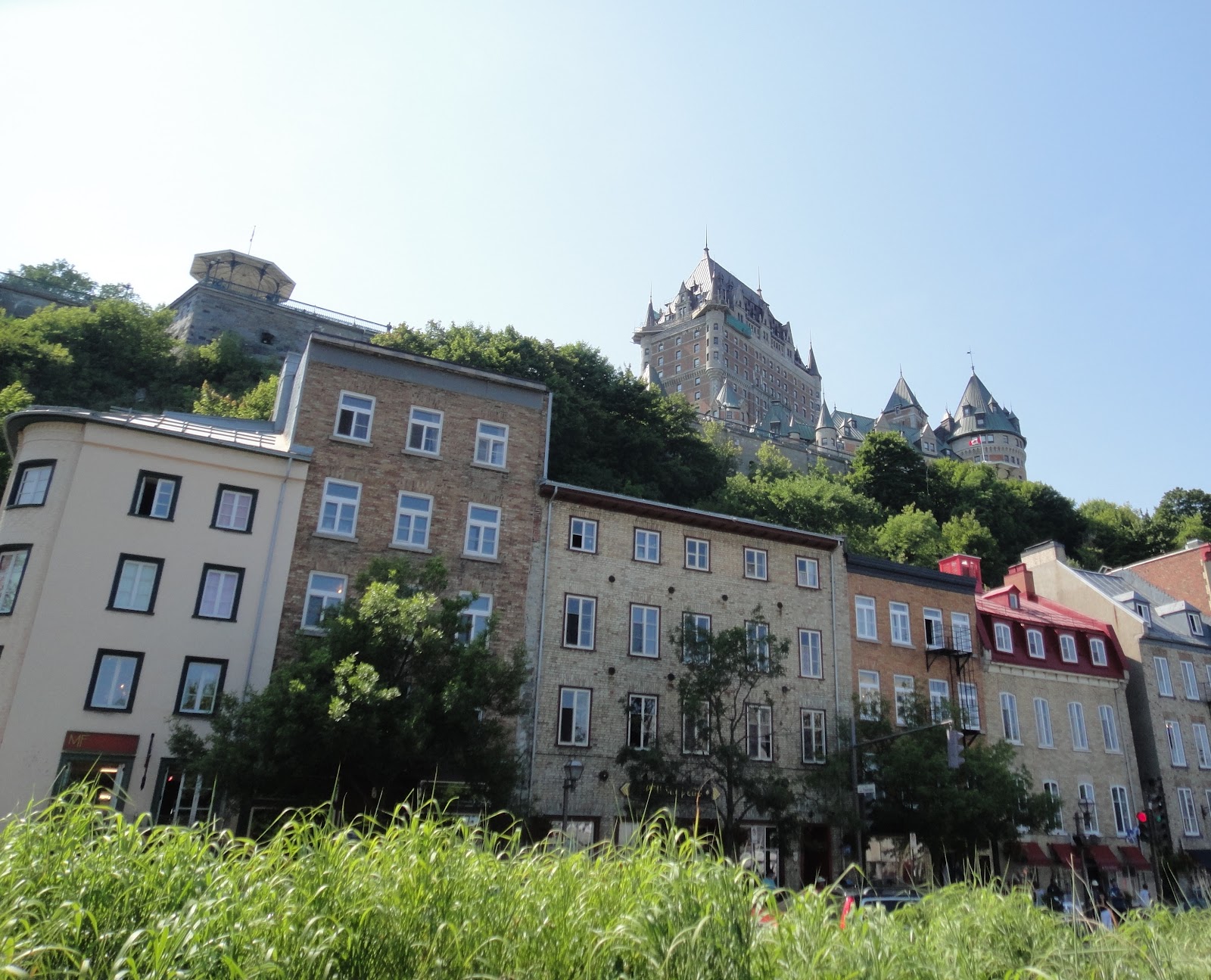
The main iconic building is the enormous Chateau Frontenac which is a hotel built in a pseudo-medieval style. It dominates the main square of the Place d’Armes and the skyline of the city. Jugglers perform in front of the statue of Champlain in the Place d’Armes and artists sell their wares in little side streets.
 Chateau Frontenac

Place d'Armes


Statue of Champlain and Entertainers
Artists


People wander along the wide boardwalk of the Terrace Dufferin which runs along the escarpment below the Chateau Frontenac and take photographs of each other posed on the canons and admire the views of the river and peeks of the lower town below the city walls.

Terrace Dufferin


Basse-Ville and St Lawrence River


A flight of steps and a funicular lead down to Basse-Ville with its quaint 17th and 18th century buildings which nestles below the city walls and beside the river. It feels like a stage set for a grand musical or pantomime and this feeling is enhanced by the fact that there is a festival of New France going on in which local people wander around dressed in period costume. They are having a fine old time acting in character and talking to the tourists.

Basse-Ville


Basse-Ville Roofs and Chateau Frontenac

 Locals in Period Costume


Lace Makers

Trompe d’Oeil

I take the public ferry the short journey across the river to the little town of Levis just to get the view of Quebec from the water.

Ferry to Levis


Quebec from the River

Quebec’s importance as a port declined once steamships could reach Montreal. The old market building is now a busy farmers’ market and berries of all varieties from the nearby Ile d’Orleans look colourful and fresh on the stalls.
Berries in the Marche du Vieux-Port

Old Town from the Marina

The big top of Cirque du Soleil is set up in the old port. I have never seen this show and I buy a ticket for the afternoon performance. As I enter the big top the man who takes my ticket wishes me, ‘Bon spectacle’. The show is amazing, with the most talented gymnasts, aerial acrobats, a juggler, tight-rope walkers, live band and singer. The costumes are elaborate gothic fantasy and the acts are strung loosely together with a bit of a love story. There is a girl who dives into a half-sphere tank of water and then does dripping gymnastics and contortions balanced on a vertical pole. The audience silently watches another girl who picks up bones of increasing length with her feet and carefully balances and constructs them into a skeletal structure. To begin with I think she is attaching them together somehow and then I realise that it is all totally self-supporting. At the end of the act she touches the smallest bone and the whole thing clatters to the ground. At the end of the show the whole audience surges to its feet in appreciation. It truly is a ‘bon spectacle’ and a modern twist on traditional circus skills. I thoroughly recommend it if you ever get the chance to see it.

Cirque du Soleil


On my last day here I take an antidote to city sightseeing by arranging an excursion to a nearby national park. It’s just me, a French girl from my hostel and Luc, the local guide. I am pretty happy to be putting my walking boots on for the first time in 3 weeks. Our first activity is a short trek uphill through a broadleaf forest of mainly maple trees to a look-out over the river and as we climb Luc explains interesting things about the forest.
Path through the Forest

View from the Path

View over the Valley

We then have a pleasant picnic lunch by the river and afterwards join a park ranger and some other tourists for a paddle on the river in a traditional-style boat called a rabaska. The ranger gives plenty of information about the local wildlife, but as it is French, Luc translates for me. While we are paddling it starts to rain. It quickly becomes very heavy and we are soon soaked through. Just as we are beginning to feel we might get cold the sun comes out again and by the time we get back to the jetty we have pretty much dried off.
Riana, Luc and Lunch

River

Rabaska

We then join another park ranger and group for a visit to some rock shelters, formed when huge chunks of rock fell from the cliff above and landed higgledy-piggledy, creating spaces underneath and between that we climb and crawl through. The rocks in this area are covered in a delicate ecosystem of lichen, moss and ferns that mean that eventually whole trees grow on them.

Climbing through the Rocks

On our way out of the park we visit a beaver dam and we are lucky enough to see 2 beavers swimming to and from their lodge. I learn at least two new things about beavers. 1 is that they are nocturnal and the second is about the purpose of the dam. I had always thought it was to trap fish behind the dam, but I learn that beavers don’t eat fish. They create the lake to provide watery protection from predators as they swim around collecting wood to eat and they also use the water to keep the cut wood fresh.
Beaver lodge

Beaver


Wednesday, 1 August 2012

Montreal

The bus journey from Ottawa to Montreal is 2 and a half hours and crosses into a new province for me, from Ontario into Quebec Province. During this time I read about the province and the city in my guide book. I learn that French is the official language of Quebec Province and that Montreal is on an island in the St Lawrence River and it is as close to the European coast as it is to Vancouver.
I check into my hostel, which is correctly named Montreal Central. It is more like a small hotel than a hostel, with a pleasant lobby bar. I am staying here for 4 nights and have booked a bed in a mixed 8 bed room – mixed as in male and female, but for the first night I find that I provide the only ‘mix’; it is me and 7 young men. Not a problem, particularly as nobody snores, unless it’s me, which I can’t hear.
Tonight I am meeting up with Mary and Ali who I met around the campfire at the Lake Louise hostel when I was there with Brigitte. They taught me how to toast marshmallows and make them into a sandwich with chocolate and biscuits. They live in the suburbs of Montreal and they collect me from my hostel and we take a short walk in the streets around the hostel and thery point out various locations to help me get my bearings and make helpful suggestions for things I might want to see in my time here. They tell me a bit about what it is like to live as anglophiles in French-Canada. They take me to a great vegan restaurant which has the laid-back informal atmosphere of a diner and we share 3 choices from the menu.
Dinner with Mary and Ali

For desert we visit a frozen yoghurt place, called Yeh! which is a favourite of theirs. It’s painted bright pink and it's help yourself to the various flavours from the yoghurt machines and then add toppings of your choice. I go for2 flavours; cheesecake and black cherry, with chocolate raisins on top and we sit in the front of the shop to eat, convincing ourselves that it’s all completely healthy of course.
Yeh! Frozen Yoghurt
After we have eaten we head for the top of Mont Royal for a lookout over the city at night, but on the way we stumble across a lively Peruvian festival in a park. It is just coming to an end, but we just catch the last song from the band and blend in with the crowd of dancers with a few salsa steps and some arm waving.
Peruvian Festival


Then we drive up the hill and join the crowds who like us have come to admire the city at night. There is a large open plaza and people lean against the balustrade, looking inwards to have their photo taken, or outwards to the beautiful view of the lit-up city.
Montreal at Night


Looking at the View
On the way back down the hill we stop at another lookout for a slightly different view. This stop is party-central and young people lean against car bonnets with music playing. Racoons scavenge fearlessly among the cars and one is even head down in a rubbish bin. We all laugh as I comment that the racoons smell rather like foxes and Mary corrects me to say that what I am smelling is pot, not racoons!
Racoon


Mary and Ali drop me back at my hostel and we say our goodbyes. I have had a great evening. It was lovely to get to know them a little better and a great introduction to their city. Maybe they will come and visit me back home some time. I hope so.


Just round the corner from my hostel is the gay village. I walk through it on a Monday morning, so am probably not seeing it at its most lively. There is a sculpture that you have to stand in front of for the individual letters to line up so that you can read it. I think it says something like:
‘We believe the differences enrich the village rather than divide it’
Gay Village
Gay Village Sculpture
I walk down to the old port on the St Lawrence River. As I walk the streets I hear French being spoken more than English. At the entrance to the port is a clock tower which has been here since 1912 as a memorial to Canadian merchant seamen who lost their lives in the First World War and then to all Canadian sailors who lost their lives in combat. A container ship goes past against the fast flow of the river heading for the modern port.
Marina and Clock Tower
Container Ship on the St Lawrence River
Clock Tower

The tower is open and 192 steps lead up past the clock face to an observation deck. The last 50 steps or so past the clock face are via two narrow spiral staircases and I concentrate carefully on the steps to keep calm enough to complete the climb.
Behind the Clock Face

Views from the Clock Tower


At the other end of the old portarea is the start of the canal.  The success of this enterprise helped make Montreal the biggest inland port in the world.

Canal

Back from the river front is the old town of Montreal, which feels very French. The sun beats down and everyone chooses the shady side of the street and seeks out the shade in the squares and parks where they can. In the main tourist streets people sit outside the restaurants under the shade of awnings and umbrellas. I sit in the square in front of the Bascilica of Notre Dame listening to two musicians play. Sitting on the bench behind me two young women chat about buying a dress – not a fancy prom dress, just a good dress that can be worn on any occasion, like going to a restaurant. The words of their conversation switch naturally between English and French even within the same sentence.   
Basilica of Notre Dame

Musicians in the Place d’Armes
 
Fountain in Place de la Dauversiare
The statue of Nelson is the city’s oldest monument (pre-dating the bigger English Trafalgar Square version) and was funded by anglophone Montrealers who were delighted by Nelson’s defeat of the French at Trafalgar.
Statue of Nelson and Place Jacques-Cartier
Rue Saint-Paul
Marche Bonsecours


My next significant encounter takes place at a table outside a coffee shop. While drinking a coffee I get talking to Steve who gives me some great tips for where to find good bagels and the local delicacy of smoked meat. Then he tells me that if I have 15 minutes he can give me some advice that will be a gift that will change my life. I am in no hurry and am happy to hear what he has to say. He talks at me for half an hour, telling me such things as the importance of choosing the correct path through life; that the world’s great people such as Ghandi, Jesus Christ, Nelson Mandela inevitably had enemies; that decisions should never be made from an emotional place; that everyone will die and that we are all remembered for the decisions we make rather than the wealth we accumulate and finally that I should take at least 1 hour every week to remember these things. Then he holds my hand and says a prayer for me to help me live by these tenets. He says meetings such as ours are never a matter of chance; that God has spoken through him and that something great has happened here today. I thank him and then go up the street pondering the encounter to buy one of his recommended bagels.
I take a walk up Mont Royal to get a day-time view over the city and to leave the busy streets behind for a while and enjoy the relative quiet of the park. I sit on the grass at the top to eat my bagel and a squirrel comes to share it with me. He is brave enough to come right up to my feet and almost reads my map.

View of Montreal from Mont Royal

Squirrel
Outside residential buildings there are rubbish bins and bag on the pavement, not in a great pile kind of way, just waiting for collection. Some of the parks, away from the main tourist areas, are scruffy and rather unkempt. As a pedestrian it is important to watch your step as the pavements are not so well-kept and can trip you up. There aren't pedestrian lights at all road junctions and to begin with I play follow-my-leader with people who seem to know how to cross a road, as I am not sure how to read the traffic lights safely, as vehicles can often turn right on a red light.
 There are many beggars on the streets and colourful characters hang out in parks, looking as if they have no-where else to go. There is a lot of graffiti art and I pass a police car that has pulled up for the officers to talk to a couple of young men who are painting on the pavement.  It all adds up to an edgier side to Montreal than I have seen or felt in other Canadian cities.
Graffiti


Grungey Retro Shop

The beautiful old town houses have metal steps leading to the first floor. This is where the family entered, up and away from the mud and dirt of the original streets. Most of these houses have now been divided into apartments.
Old Town Houses and Rubbish for Collection

On my last evening I wander down the road to go to the supermarket and pass a bunch of policemen on motorcycles parked up on an empty hot just by the hostel. There are loads of people gathered in the park and something is going on. At the back of the park there are mounted police and police on foot wearing helmets. At first I think it is a festival, but it doesn't seem quite right for that and I realise it is the beginnings of a demonstration. When I come back from the supermarket the crowd is banging on drums and anything that will make a noise and a group of policemen are escorting a couple of demonstrators off site.
Police at a Demonstration