Wednesday, 7 December 2011

Cremation

Religious ceremonies play an enormous part in Balinese life and Made, who I was with yesterday, told me that a cremation can be the most expensive of all ceremonies, along with a wedding. A family can spend up to 15 million rupiah (about£1200) on an elaborate cremation ceremony. Many people cannot afford an individual ceremony and the body can be buried for up to three years and later cremated in a mass ceremony. The Balinese have a complicated calendar, which lays out the auspicious days for everything from starting to build a house, to a wedding or cremation. When I arrive in Ubud the guest house owner tells me that there will be a big cremation in two days time. It is quite acceptable for tourist to watch and follow the procession.

On Tuesday morning when I go out onto the street the preparations for the cremation are laid out in the road in front of the temple. There are two structures, which look rather like carnival floats. One is an elaborately decorated tower on top of a raft of bamboo poles. This is where the body will be placed to be carried to the cremation site. There is a photograph attached of the old lady in her younger years.
Funeral tower

In front of this there is an enormous model of a red mythical beast with the head of a dragon and the body of a bull (complete with balls!). This also sits on bamboo poles and will be the funeral pyre. Various people are gathering in the street as the preparations are made. There are the family members and local people, as well as tourists. The women of the family are colour-coded in orange. The atmosphere is convivial and light-hearted and people are chatting and laughing together.
The women of the family and the funeral pyre structure
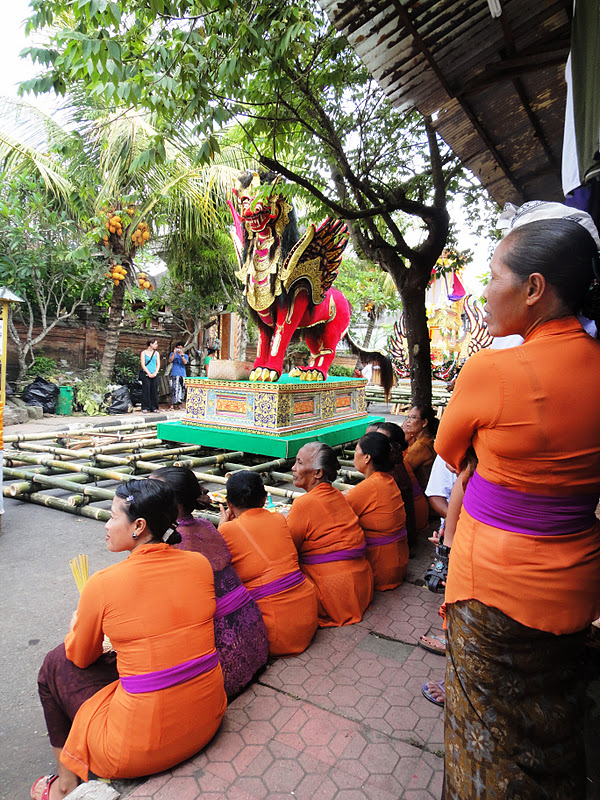


I don’t understand the significance of most of what I see, so I will just describe the events. In front of the red dragon is another small structure in which a holy man is sitting making various complicated preparations with flowers, incense, beads, bells and water.
Priest

 The men who are helping with the ceremony are all wearing white team T shirts with ‘6 December 2011’ printed on the left breast. They rows on palm mats on the road, waiting. They chat and laugh and gently josh with each other. Then the women of the family start anointing them, by going between the rows and applying different things to their hands and fingers and then splashing them with water.When this is complete they all pray silently and solemnly. Then they get up, like it's all over and go into the temple for something to eat and drink

Annointing the men
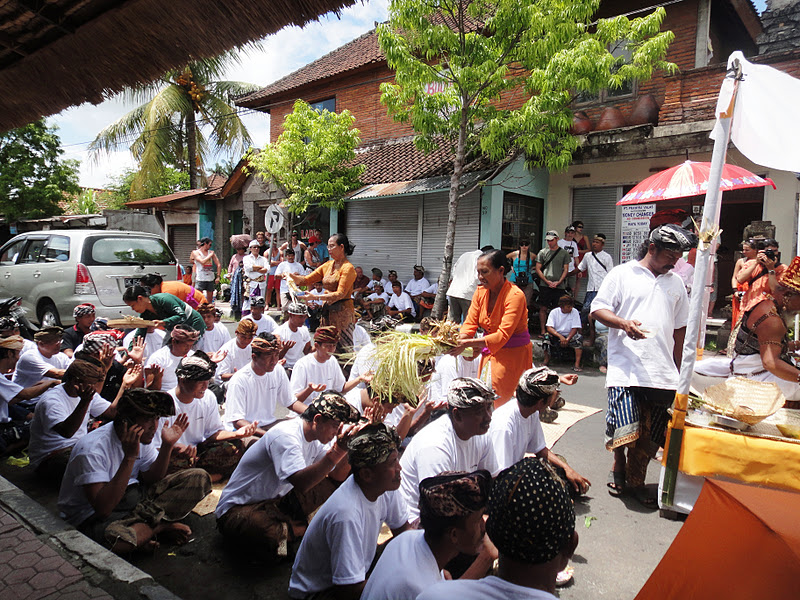

Men praying
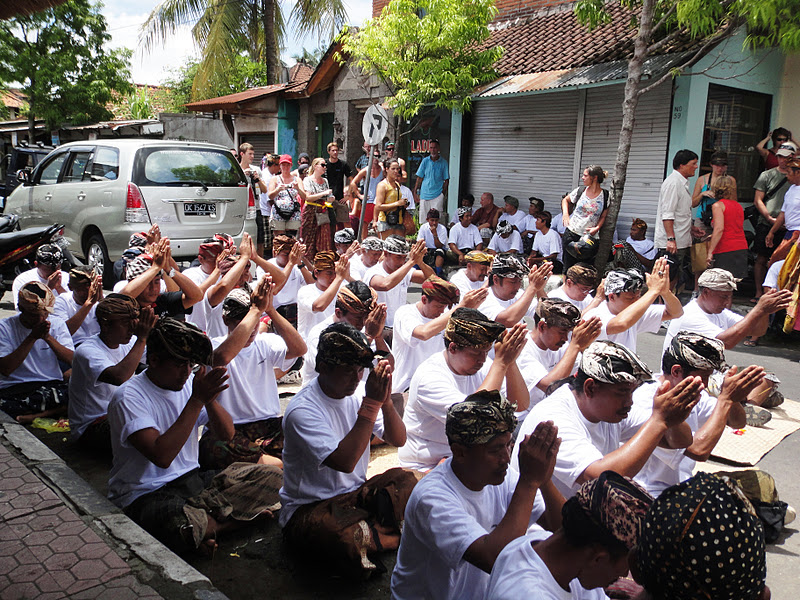

Many photographs are being taken, by tourists and locals and what look like professional photographers. There is even what looks like a television or big video camera getting in amongst it all.
Photographer


There is obviously not disrespectful to touch the prepared structures, as one local man lifts two small boys up onto the beast to take their picture and children are clambering and jumping around the bamboo poles. Two small children lean against the hearse structure and play a game of‘scissors, paper, stone’.
Children playing ‘scissors, paper, stone'

Boys being photographed on the funeral beast

Men climb up onto the tower structure and prepare the place for the coffin with material with they attach and then the white wooden box is lifted up and put in place.

Preparing the tower for the coffin

This whole process has taken about an hour and a half. All along the street a large crowd has gathered and people have stopped work to stand at the front of their shops and restaurants and it is time for the procession. First comes the red dragon; then a very loud percussion band; then the women of the family carrying things on their heads; then the tower with the body.
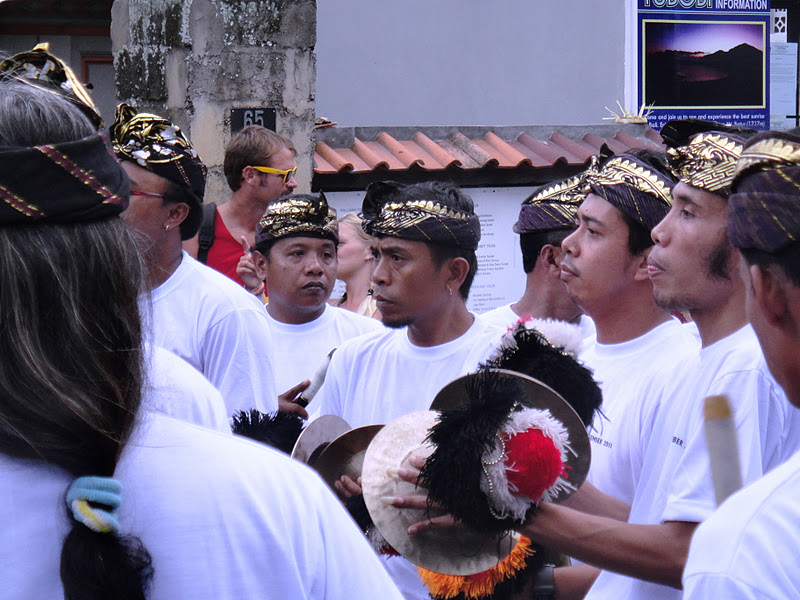
Accompanied by the percussion music, the men in the white T shirts take their places on the bamboo poles and the structures are lifted up – not in the slow and dignified funeral crawl we are used to, but with much shouting and shaking of the structures. They run forwards, then lurch sideways and turn it round in circles, while people with hose pipes splash them with water. Every so often they stop and put the structures down and the man laugh and take a rest. My guide book tells me that the body is considered as little more than a shell for the soul and the spirit in the corpse has to be confused, so that it cannot find its way back to the world and can be liberated by the cremation for its evolution and reincarnation.

                                                    Preparing to start the procession


Percussion
Women of the family

The procession carries on down the road like this for about half a mile until we reach the cremation site within the Sacred Monkey Forest.
Arriving at the cremation site

In the forest there are some rough graves with small head stones and small offerings are scattered around. These are interred bodies awaiting a cheap mass cremation at a later date.


As the area becomes full with people the graves are walked all over and no one seems bothered by this.

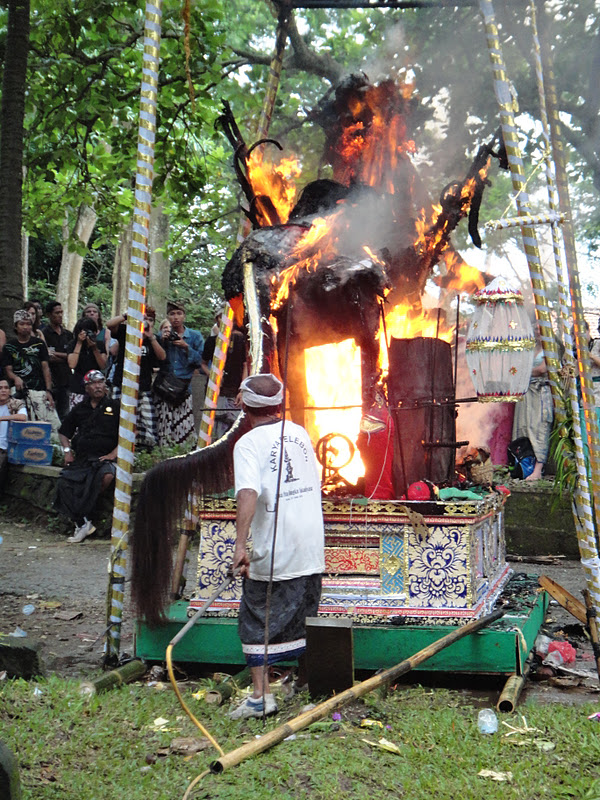
Once inside the forest, the funeral prye red dragon is placed within an awaiting structure of poles with a canopy.  The coffin is removed from the tower and walked 3 times round the pyre. Men use knives to  cut the back off the beast and the women of the family climb up and drap their hair into this space that is awaiting the body. The body is removed from the coffin and placed into the back of the beast in its shroud. Then family members climb up and carefully cover the body with different pieces of material and maybe some of her clothes, flowers and the offerings that the women have been carrying on their heads.

Everything is ready


While this is going on a second similarly grand funeral procession arrives, but this time the coffin is small and pink. When I ask the women at my guest house about this later she says it is a small child who climbed and fell. Her English is not good enough to explain any more. nce again the people attending this cremation do not appear to be sad in any way.

Small pink coffin


The family light bunches of reeds and put them under the beast and it starts to burn immediatley.


Then a  man pulls up a metal tank and squirts petrol into the bottom of the fire. Another man has a hose pipe and spays water where necessary to stop the trees catching fire.

Adding fuel to the fire


The family sit around nearby to watch, with tourists on both sides of them.

The family watch


Soon after this I leave. I understand that there will then be a visit to the temple and then a visit to the beach to float the ashes away on the sea.


Tuesday, 6 December 2011

Bali family life

I have arranged to meet up with Made (pronounced Marday), who was Catherine and Peter’s tour representative. He picks me up in his 4x4 and offers to take me to his village to meet his family and show me where he lives. This is a great opportunity to see real Bali life, away from the tourist areas. He is married with two young children – a boy of 2 ½ and a girl of 8. When we arrive at his house his wife and children aren’t there, but a gaggle of other small children including two of his nieces and various friends are playing out the front and they open the gates to his property and all follow us into the garden. They are shy and look at me and giggle and then continue playing. The oldest-looking and most confident boy says, ‘Hello, how are you?’
Local children at Made's house

Made shows me around his house. He is very proud of it and tells me it is very modern. Made designed it and his brother-in-law built it. It is one storey and built up a couple of steps. The floor is tiled throughout, including a veranda round the side. The walls inside are bare cement. There is a living room, which contains a television, but no other furniture. I ask him about the lack of furniture and he says they sit on the floor on mats to watch the television and sometimes they sleep in there and it’s an open space for the children to play. There are 3 bedrooms; one for Made and his wife, one for his daughter and one spare room. I’m guessing the little boy sleeps with the parents. The bedrooms don’t seem to have much in them other than beds and a few toys in the daughter’s room. Along the back outside wall of the house is a covered hall for storage, which leads to the toilet. It has a western-style toilet that is flushed with water from a bucket and a ladle. There doesn’t seem to be a shower or wash basin. Outside there is also a covered kitchen area and an eating area, which has a beautiful wooden table and chairs, which Made says are brand new and his dream furniture. The kitchen is very basic, with two gas burners and a gas bottle underneath, a stainless steel sink and drainer and a storage rack for plates etc. Pots and pans go on the floor under the sink.
Kitchen

I would say this family is pretty well-off, compared to other local village people. Made works about half the week as a tour guide and his wife works mornings only in a local bank. They have a car and two scooters and their own house. I ask him what he does in the afternoons and he says he spends the time with his family. He says that sometimes he thinks he could do with more money, because there are always expenses, but they have decided that they have got the balance right.

I have seen many other home compounds dominated by elaborate home temples and I haven’t seen anything like this at Made’s house. When I ask him points out a couple of palm constructions at one side of the garden, which I took to be garden sheds. These are his temporary temple and will be made more permanent as he get the money to do so. He says that Balinese people spend a great deal of time and money on their religion. For example offerings need to be made several times a day and there are many ceremonies and celebrations to make throughout the year. Originally people made the offerings themselves, which took a lot of time. Nowadays people mostly buy the offerings ready-made which is quicker, but more costly.

Made’s wife and two children arrive home on a scooter. She is quite shy and doesn’t speak any English, so we smile at each other a lot and Made translates for us. The little boy is clutching a new toy that he had bought for him today. It is a battery-operated car that plays a tune and turns into a robot. I notice that is front top milk teeth are stumps and Made says, ‘Too many sweets’. Made suggests a trip to the nearest beach and he and I get in the front of his car and 6 children and his wife get into the back seat. There is also a helium balloon that the little boy is carrying – so that makes 10 of us. The girls sit on each other’s laps and the little boy stands between the two front seats. The only seat belt is for the driver.
Back seat passengers

We arrive at the nearest beach, which has black volcanic sand. There are only local people here enjoying the evening. Some are sitting on a wall at the back of the beach; there are a couple of people cooking and selling food; some people are playing in the sea. At the back of the beach is a temple and the sand is littered with the palm leaf remains of thousands and thousands of previous offerings. This beach is just along the coast from Sanur, where I had been staying with Peter ad Catherine. I remark about the difference in the sand and made tells me that the white sand on Sanur is imported.
Black Beach

Made drops me back to Ubud. On the way I ask him what his hopes are for his children in the future. He thinks for a while and then says that he would like them to become doctors and then they can work in other countries in the world. Then he adds, ‘Either doctors, or work on the cruise ships.’It has been a lovely afternoon and privilege to catch this glimpse of his life.


Ubud

Peter and Catherine leave the hotel in Sanur early in the morning to fly back home at the end of their holiday and I am left on my own to enjoy the last half day of luxury in the hotel before reverting to my solitary backpacker existence. I have to remember how to make decisions for myself! I decide to travel inland to Ubud, which is the art and culture centre of Bali and now also famous as the ‘love’ part of the book and film, ‘Eat, Pray, Love’. Making the last possible use of the hotel facilities, I ask the hotel concierge to book the bus trip and the cheapest room I can find in the Lonely Planet guide book. I catch the bus to Ubud which only takes 40 minutes and check into my guest house which is down a narrow back street and has 4 individual rooms to rent. The door to my room is ornately decorated with red and gold and I have a balcony which overlooks the family compound, containing the family temple.
My balcony
View from my balcony including family temple

Traditional family houses in Bali are built within a compound wall, inside which are various buildings, or open-sided pavilions which serve as sleeping accommodation and areas for the family activities. There will always be a temple in the north east corner. The way the whole thing is laid out has strict rules and is oriented on a mountain/sea axis. The design is to keep the evil spirits out and appease the ancestral Gods.

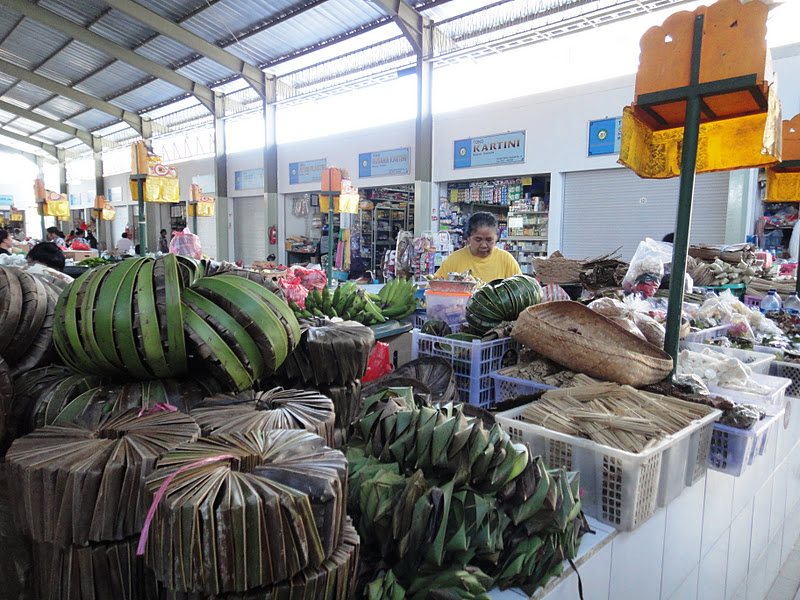
I take a walk around Ubud. It has a large market which is busy in the very early morning with locals buying fruit, vegetables and the necessary items for offerings and tourists later in the day. The main streets are busy with traffic of cars and motor bikes and have the usual temples, tourist shops and restaurants; but there are also some very upmarket clothes and jewellery shops, organic health food restaurants and art galleries.  I go into an English bookshop and buy a map of Bali, a copy of ‘Eat, pray, love’ and a Bahasa Indonesian phrase book. All along the streets there are men sitting on the pavement and in doorways, who call out hopefully, ‘Transport?’, or, ‘Taxi madame?’  and do a little driving mime with their hands. I reply in my best Bahasa Indonesian, ‘Jalan jalan’, which means, ‘I’m walking’.

Ubud and the surrounding area has several art museums. I visit one in the main town which exhibits paintings to show the history of Balinese painting. It only takes me about ½ an hour to walk around and that’s because I feel that taking any less time might seem rude and I realise I’m not very interested in the history of Balinese painting - hummmm, maybe it's all art really! I don’t think I’ll bother searching out the other local museum and gallery options.

Not far outside the town it is possible to get away from the hustle and bustle and walk into the countryside through rice fields and neighbouring villages.

Countryside and rice fields around Ubud


Ubud is also a good place to see Balinese dance, of which there are many forms. I go to a show one evening of Barong and Ranga dance, which tells the age-old tale of good versus evil. It is rather like a pantomime, with elaborate costumes and even a ‘he’s behind you’ episode. In many ways it is very similar to the dance I saw in India.

Scenes from the Barong and Ranga dance


The performance is accompanied by a percussion orchestra, called a gamelan. The musicians sit cross-legged on low stools. The main instrument is the xylophone-like gangsa, which they play with what looks like a little wooden pick axe. The speed, volume and intensity of their playing reflects the action on the stage.

Gangsa players


Sunday, 4 December 2011

Bali with Catherine and Peter – Nusa Lembongan

On Catherine and Peter’s last day in Bali we make an excursion to nearby Lembongan island. It is a 30 minute trip in a fast boat. To begin with the boatmen have to punt the boat out of the reef shallows and then we speed across a calm sea until in the middle of the crossing we hit rolling waves that make the boat and the passengers leap about a bit. 5 loud Australian girls sitting in the back get louder still and shriek excitedly.
Boat trip to Nusa Lembongan

We arrive on a beautiful white beach where small boats are moored. The sand is sharp with broken shells and pieces of coral. Small bungalows for tourist to stay in hillside above the low cliff and the back of the beach has a walkway and a few restaurants. It’s a quiet, traditional island which is becoming more popular with tourists.
Jungutbatu beach

The island has about 1500 inhabitants and 80% of them are employed in seaweed production, which is exported for use within the food and cosmetic industries. Carrageenan is an emulsifying agent used to thicken ice-cream, cheese and other foods; it is also used as a fat substitute in diet foods. The waters around the island are shallow and rich in nutrients and the locals grow the seaweed on the bottom of the sea on patchworks of bamboo and ropes. The locals wade into the water and collect the seaweed in baskets which they float on rubber inner tubes, or in shallow boats.
Seaweed collecting

We are going to do some snorkelling and we collect our masks and fins and transfer to a traditional boat with 7 other tourists to be taken out to a good site. We pass people collecting seaweed and boats taking out tourists for fishing and diving.
Traditional boat

The outboard motor doesn’t sound too healthy and after a while it stops altogether. We bob around gently and chat amongst ourselves while the boatman tries to fix it. He fiddles with it and changes the plugs, but no luck. He says he’ll get another boat for us, but in order to get a phone signal he has to punt the boat to a more favourable spot, where he throws in the anchor and we wait to be rescued. We are not at all worried; the weather and view are lovely and if the worst came to the worst we could wade to the shore. After about ½ an hour another boat pulls up alongside and we all climb out of one and into the other boat. We leave the stranded boat and boatman behind and carry on to the snorkelling spot.
Abandoning ship!

Snorkelling on a coral reef in warm tropical waters is a new experience for me and I am amazed by the varieties and colours of coral and fish.
Snorkelling

After the snorkelling we return to the shore for lunch.
Lunch

After lunch we have a short tour of the island in a open-sided truck.  We drive along the coast passing through areas where seaweed is drying on plastic sheets amongst palm leaf and huts. These huts are not lived in, but are used by the workers during the day.
Seaweed drying and workers' huts


We come to a mangrove forest and take a short trip on a punt. It is blissfully quiet and through the crystal clear water we can see bright blue star fish lying on the bottom.
Mangrove forest boat ride
We then drive along the length of the island to another village. This one is very traditional, with each house having a large home temple within its grounds. We visit a very strange ‘underground house’ which is dug out of the rock with a  network of rooms; interconnecting passages and chimneys. There is a board with a history of the place, but it is written in pidgin English in such a way that it is hard to make sense of it. It seems to have been built in the 1970s to replicate a cave house that featured in an old story as protection for a family. We climb down a step stairwell and clamber around inside, having to keep our heads ducked down I don’t know if anyone actually lived here, but if so they must have been midgets!
Underground house pssages

It’s then time to leave the island and we scoot back to Bali on the fast boat.
Leaving Nusa Lembongan

It’s Catherine and Peter’s last night and they fly home again tomorrow. We have a last meal together and then say our goodbyes in the early morning. Thanks for a great holiday! 

Bali with Catherine and Peter

The holiday with Mum finishes in Singapore. The tour group is due to fly back to Heathrow late in the evening. There is a strike by Heathrow immigration officials today and no-one yet knows what effect this will have on their journey. My flight to Bali is earlier in the afternoon, so Mum and I say our goodbyes. It will be another 9 months until we meet up again next September. Mum says, ‘Well I waited 9 months to have you, so I can wait 9 months again.’
My flight is only 3 hours and I am looking forward to meeting up with Peter and Catherine, who are already on holiday in Bali.  I am joining them at their hotel for 4 nights and after a taxi ride from the airport I arrive at the Bali Hyatt in Sanur, where they meet me in the lobby, looking relaxed and sun-kissed. We have a drink and a sandwich together and start to catch up with the last 3 months since we last met.

The hotel is fantastic and is right on the beach. It has 2 swimming pools, one with blue tiles and one more natural,  with plenty of sunbeds under shady frangipani and palm trees and beautiful grounds.
Swimming pools


Hotel gardens

In the lobby a pair of local Balinese men play a gentle plinky-plonky tune on xylophone-type instruments.
Plinky -Plonky Musicians

Catherine and Peter comment that the accommodation blocks are unfortunately built in the style of a 1970s multi-storey car park, but they blend in with the vegetation, so that they become almost invisible.
Multi-storey car park-style accommodation buildings

My room is wonderful and spacious, with a balcony overlooking the gardens. As I unpack later that night I look for the wardrobe and am surprised that it has two narrow louvered doors; it doesn’t look big enough for the room; but when I open the doors I laugh out loud because it is a huge walk-in wardrobe!
It is even hotter here than in Singapore and this is the hottest place I have been. The humidity is so high, so that your sunglasses mist up as you leave the coolness of the air-conditioned bedroom. We spend the day quietly in and around the swimming pools.
When the fiercest heat of the day is over Catherine and I have a swim in the sea. The beach is protected by a coral reef and the water is as warm as a bath. When the tide is in the water is only shoulder deep and when the tide is out you can wade right out to the reef and not get your shorts wet.
Sanur beach
Fishing boats at Sanur beach

In the evening we take a taxi ride to another beach, Jimbaran, on the west coast to see the sunset and we are not disappointed – it is doing its thing right on cue. Jimbaran Beach is beautiful crescent of white sand, with many restaurants right on the beach, which are busy in the evening as people take in the view and eat seafood for dinner. After a walk along the beach we sit at a table and drink a beer as the sun goes down and the sky becomes streaked with red and orange.
Jimbaran


My guidebook tells me that the first Europeans to set foot in Bali were Dutch seafarers in 1597 and when the captain Cornelius Houtman prepared to set sail from Bali, some of his crew refused to leave. I’m not surprised – what I have seen of the island so far is truly paradise.
The next morning Catherine and I take a short bike ride in the local area with a guide from the hotel.
Catherine and our bike guide

First of all we cycle along the paved promenade at Sanur. This extends about 5km between the hotels and restaurants and the beach. The tide is out now and a few local fisherman are wading in the shallows looking for small fish. We then cycle inland to the main village of Sanur and visit a local market. This market is very similar to the others I have seen in Asia, selling fruit, veg, meat and fish – but with added religion. Although Indonesia is a mainly Muslim country, Bali has its own version of Hinduism and their religion plays a huge part in their daily lives. There are temples everywhere from bigger local temples to small ones and shrines in each house, shop, restaurant and workplace and several times a day offerings of flowers, fruit, food etc are made to the Gods. In this market each of the stalls has its own golden temple on a stick and many of the stalls are selling the paraphernalia associated with their religion and making offerings.
Market stalls with their own temples
Temple items for sale

Some stalls sell ready-made offerings and also the separate bits and pieces if you wish to make your own – palm leaves, rice cones, flower petals, incense sticks etc. The locals spend a lot of their time and money doing the right thing by the Gods.
Offerings stall

After the gentle exercise of our bike ride some more serious lazing by and in the pool is in order to escape the midday heat. We manage to summon enough energy to swim lazily over to the swim-up bar and order ice-cream sundaes.
It’s a tough life – but someone has to do it!

In the evening we go to visit Kuta Beach. This is where tourism first started on Bali. It was a stop on the hippie trail in the 60s and then became a surf spot and now it is a crazy maze of shops, bars, restaurants and alleyways, known as ‘gangs’, that spit out motorbikes when you are least expecting them. We arrive on the beach just as the sun goes down and walk along among the Muslim locals and western tourists and watch the people who are still in the sea.
busy on Kuta Beach in the early evening

There are no bars as such at the back of the beach, but locals have insulated boxes containing cold drinks and plastic chairs for us to sit on and locals play guitars and sing.
A beer on the beach with the locals

We get talking to a young man who comes from Sumatra, who is currently living and working on Bali. He says he comes to the beach every evening after work and he has made friends with other Sumatrans. We ask him about Bali and he says it is a great place, but he says the Balinese are lazy and it’s the Javans and Sumatrans who have the jobs. We leave them to their beers and music and walk away from the beach up a gang that is packed with stalls selling T shirts and sarongs. Back in the main street the bars and restaurants are belting out western music and it's only 8.00pm. We find a relatively quiet restaurant that has free wi-fi and I manage to Skype Katie, but it is too noisy to be able to have a conversation. After our meal we take a taxi back to the quieter resort of Sanur and leave the excitement of Kuta to the young people - I'm sure it will all be happening until the wee small hours.