Friday, 7 October 2011

trekking day 1


We set off from Kathmandu on our tour bus and drive out of Kathmandu valley going west. The porters for our trek come with us. Amazingly this road is the only route in and out of the valley, so it takes all the traffic. We reach a check point on the brow of a hill and suddenly we have left the valley behind, with its brick factory chimneys and houses and we are instantly in a different landscape. Steep sided hills and valleys open up in front of us and the road in and out of the valley winds around the sides of the hills.
Coming towards us in the opposite direction is a constant stream of colourful lorries and buses crawling up the twisting road. The buses are so overcrowded that men sit on the roof with the luggage and the occasional goat.
Bus


Along the road-side are many open-fronted shops and tea shops. They cling on stilts at the back between the edge of the road and the almost sheer valley. People are living their lives and working right beside the dusty road. The landscape is so steep that this narrow band is the only place available. After a few hours we stop at a road-side restaurant and have a cup of Nepali tea. It is sweet and milky and flavoured with cardamom and cinnamon.
Tea stop


We often pass goats being herded out of the hills and along the roads and Anil tells us that today s the first day of the main Hindu festival of Dashain. This will go on for 15 days and part of the celebration includes sacrificing huge numbers of animals. These goats are going to meet a sticky end.
Goats

After 6 hours of driving we arrive at Pokara, where there is a beautiful lake. Beside this has sprung up a collection of hotels, shops and restaurants for the tourist trekkers. The whole place is full of people either preparing to go trekking or relaxing after coming back from the mountains. There are endless outdoor shops where you can buy or hire all your trekking gear – but no genuine labels in sight apparently. This is also the area where the two ethnic groups live from which the Gorkha soldiers are recruited into British army.
Pokara lake

We separate our luggage, so that we only have to carry the small amount we need for each day and in pairs we can each give the porters 10kgs. They will each carry this, plus their own bag. This is an easy trek for them; during the main season hey may well carry three times this amount! The next day we drive again, this time for 2 hours out of Pokara valley and up into the foothills of the Annapurna range, which is part of the Himalaya. Our trek will be for 3 days at low altitude, with the highest point being 2100m. Himalaya literally means 'house in the snow' in Nepalese and we are hoping to catch some glimpses of snowy mountain peaks, but that will depend on the cloud cover.
As we drive along the valley floor we pass several Tibetan refugee camps. They are beautifully kept, with brightly painted houses and pretty gardens.
Leaving Pokara valley
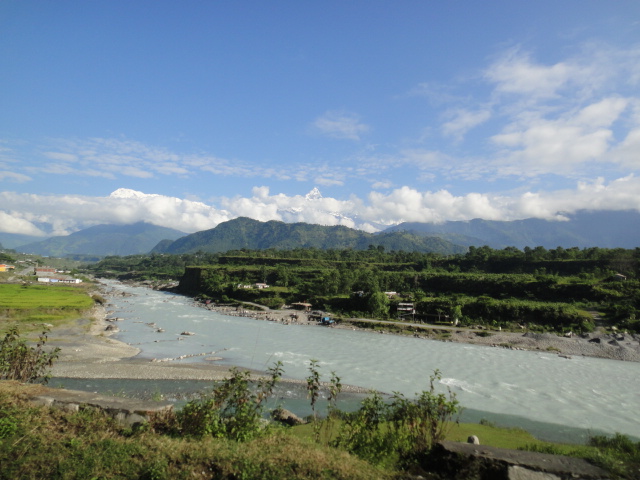

Our trek begins at a small market town, called Birethanti, which serves the surrounding area. Here the cargo from lorries is unloaded onto mules, or baskets carried on people's backs, to take the goods into the settlements higher up in the hills. We start off walking through the bustling main street. Kieran and Kristine take the lead.
The start of the walk
 

Anil tells us that this morning's walking is on flat ground and after lunch we will be going uphill. But his definition of flat and ours is not the same! We follow a track which leads out of the town and crosses a river several times before staying on one side of th valley.
Crossing the river

We climb steadily and pass through various small settlements. At one place we pass an open shed where the meat from a pig is being divided up between the villagers who have a share in it.
Sharing the pig


We pass a place where a small Hindu ceremony has taken place by the side of the track earlier in the day. A rock is stained with blood and Anil tells us that a chicken has been sacrificed for the start of the festival.
Chicken sacrifice


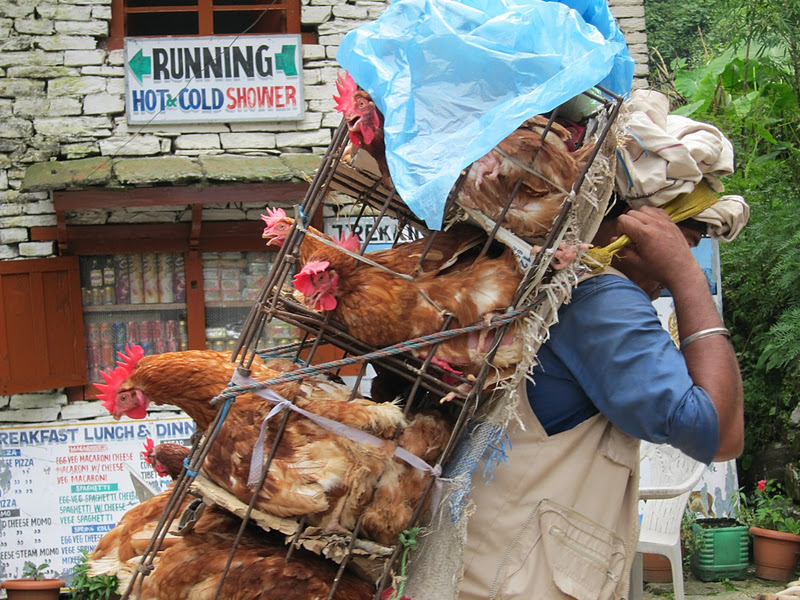
Along the path we pass men and women carrying loads in baskets on their backs. They help to take the weight by having a strap around their forehead. People are carrying stone for building, grass for animal food and there is even 1 man carrying a fridge!
Fridge man

Fresh chicken delivery (photo from Debbie, who was quick enough to get this one)
The sun is hot and after 2 hours of walking we are glad to stop at a tea house for lunch. A tea house is a combination of a restaurant and a basic place to stay for the night for the tourist trekkers.
Lunch stop


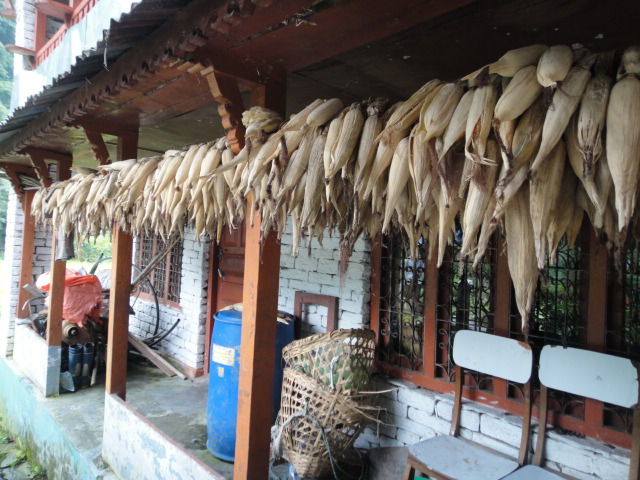
Sweetcorn drying
Straight after lunch the path takes on a different quality and we are suddenly climbing stone steps. The amount of work that must have gone into making the path must be incredible. We now understand the distinction between Anil's description of the 'flat' path before lunch and 'uphill' path after lunch – steps! When we walk on the coast path we are used to some steps, but usually you can see the top. Here there is no top. We walk up steps for 3 and a half hours.  I am very glad I brought my walking poles.
It starts to rain, but it is far too hot to put on a waterproof coat. Some of us have umbrellas and some have bought ponchos after the wet sightseeing on day 1. I have an umbrella, but now I have a dilemma – walking poles or umbrella. I opt for 1 pole and the umbrella. We stop for a rest from time to time. There are always little restaurants where we can sit down, even if we are not buying anything.
 I liked these signs at two of our stops:
NEPAL sign  
 

Steps sign

We arrive at the tea house where we are to stay for the night. Everyone is glad to have no more steps to climb. The tea house overlooks a steep valley and we can just see the top of one of the peaks, 'Fish Tail' mountain floating above the clouds. Hopefully we will get a clearer view of the range in the morning. The rooms are basic, but clean and we get a hot shower and dinner. The walls between the rooms are very thin and we can hear every noise. The porters are sleeping in a room underneath me and Kristine and we can hear them hawking and spitting before they settle down for the night. If that's going to be the worst, we can manage. We giggle and then fall asleep.
Ghandruk tea house


Tuesday, 4 October 2011

Buddhist prayer wheels and flags


The flags come in five colours each signifying a different element of life and they are always hung in this order from left to right:

Blue - sky

White – air

Red – fire

Green – water

Yellow – earth

The Buddhist chant ‘om ma ni pad me hum’ is printed on each flag. These words represent the bad things in life that we should try to rid ourselves of in our quest to reach enlightenment.

The wind carries the positive energy of the prayers away.

Prayer flags


Prayer wheels

A prayer wheel is a carved wooden cylinder mounted on a central metal rod, so that it can rotate. The Buddhist chant ‘om ma ni pad me hum’ is carved on the outside of the wheel and also written many times on paper or cloth inside the wheel. The idea is that s the wheel is rotated the prayer is send out into the atmosphere. The wheels vary in size from small to very big. The smaller ones are usually in a row and a person walks along the whole row turning each one

Prayer wheels in a row

A monk turning a big prayer wheel

Around Kathmandu


The next day it is raining heavily and we are taken to two tourist sites. The first is the Buddhist temple of Swayambhunath.  This is an ancient Buddhist site, but nowadays it combines a mixture of Buddhism and Hinduism, which reflects the way the different religions co-exist and often cross-over in Nepal. Nowadays 35% of Nepali people are Hindhu and 11% Buddhist. Anil tells us proudly that there has never been any conflict about religion in Nepal. The entrance to the site is swathed in prayer flags and there are 365 steps up to the stupa. This temple is also known as the monkey temple, but today the monkeys are finding shelter from the rain wherever the can.
Monkeys sheltering from the rain

At the top of the site is the main stupa – a stone-built platform painted white, showing the eyes of the Buddha and topped with a golden spire made up of 13 increasingly smaller circles, which signify the 13 steps to enlightenment. Around the main stupa are various other temples, shops, houses, smaller stupas and a Buddhist monastery.

Stupa

365 steps down

Prayer wheels

Carved wooden door

This statue of the Buddha was carved in the 7th century from one piece of stone.
Statue of the Buddha

We go into the monastery. In the entrance there is an enormous golden statue of the Buddha.
Buddha statue
Further inside is a beautifully decorated room where monks are praying. The tourists are allowed to watch from the door and take pictures.
The prayer room


Inside about 6 monks are sitting on the floor. They are chanting prayers, reading from books in front of them. From time to time the chanting stops and instruments start – cymbals, long wooden trumpets and a big drum all combine to make a huge clashing sound.

Monks praying


Sitting against the wall on a mat on the floor in front are two small boys, perhaps 10 years old. They are dressed in the same red and yellow garments of the monks. They nudge each other and giggle and scribble something on a piece of paper on the floor in front of them; then scrunch it up and throw it out of the window behind them.
It is still raining heavily as we return to the bus. We drive about 10km out of Kathmandu to a medieval city called Bhaktapur. This is a world heritage site. The streets are paved with red bricks and the 3 main squares are joined by a network of small streets and alleyways. There is a royal lace here, many temples and also tourist shops alongside local people living their lives. It is a major tourist destination, but today because of the heavy rain it is quite quiet.
Durbar Square

We are all very wet!

We inspect the carvings around the roof of a Hindu Temple and notice that the ones at the bases of the struts are erotic. Here is a particularly gymnastic one!
Erotic carving

The 2nd square houses the highest temple in Nepal. It has 5 stories and is dedicated to the particularly blood-thirsty incarnation of the Hindu Goddess Siddhi Lakshmi. It has huge stone statues on either side of the stairway to guard the goddess. Each pair of figures is said to be 10 times stronger than the pair below. The first pair are legendary wrestlers, then come elephants, lions, mythical beasts and finally two demi-Gods, who must be pretty powerful.
Temple stairway

We climb to the top and walk around the balcony in a clockwise direction, as dictated by Hindu and Buddhist convention.

Carving around temple balcony

A couple of Nepali women are camped at the top for the day, begging. There are 3 small boys with them, passing the time by playing marbles. They are incredibly skilful and can fire a marble from finger and thumb to hit another marble 2 feet away. I guess they have a lot of time to practice.
Marbles

Going back down the stairway we are all very cautious; it is very steep and wet from the rain and the steps are not very wide. Looking back up one of the begging women is coming down behind us, thinking nothing of the descent and laughing at us for making such a meal of it.
Stairs down

Next we go to the 3rd square which is where a community of potters live and work.
Buildings around pottery square


There are two types of clay dug outside the city – black and red. Normally the area would be full of local craftsmen throwing pots, but because of the rain it is pretty deserted. We can see some pots drying naturally under the roof of some open-fronted workshops.
Money box pots drying

Behind here is the kiln. The fires are made on the ground, using broken pottery to create air spaces. The pottery that has already dried naturally for a week, is then piled carefully in layers, with straw and sand in between. The pots are left in the kiln for a week. We watch some pots being removed from the edge of the kiln heap. The fired items are money boxes and oil lamps which will be sold locally and across Nepal. Money boxes are important because in the Hindu religion, in worshipping Gods, money is also often given to children.
Pots coming out of the kiln

Next we visit a school of traditional Tibetan Thanka art. First we see a sand mandala, which is an aerial view representation of a stupa, with its 13 steps to enlightenment. It first we can’t believe it is made from sand, it is so intricately constructed. It almost looks like embroidery. A guide explains how the monks make it by first marking out the design using rice flour and then tapping different coloured sand out of wooden tubes. They wear masks over their mouth and nose to ensure that a cough or a sneeze doesn’t destroy the work. Once made there is some sort of ceremony and then it is destroyed, to represent the impermanence of things, by gathering the sand together and floating it down a river, thereby distributing the prayer.
Sand mandala

The guide then shows us examples of the painted form of Thanka art, explaining that the pictures are painted onto cloth. There are two styles – the mandala and the wheel of life, which represents the ‘om ma ni pad me hum’ chant and the human sufferings that Buddhists seek to overcome in order to reach enlightenment.
Explanation

Painters at work


Monday, 3 October 2011

Arriving in Kathmandu


After three flights from India I arrive in Kathmandu. Immigration takes ages, even for the people with a visa. There is a group of Americans behind me in the queue for passport and visa control. One woman has a particularly piercing American voice and keeps up a commentary on the situation, ‘Well I can’t see why this needs to take so long, they should just get more staff.  Don’t you just hate having to stand in line?’ etc etc. The queue of people who are applying for visas at the airport is really long and they will be there for hours.
Coming out of the airport my initial impressions are that things seem pretty familiar. I get a taxi from the airport to my hotel. The general greeting from everyone is, ‘Namaste’, with the hands held in the prayer position. The roads and the driving are much the same as in India. If anything the vehicles are in worse condition, but the roads in rather better condition, with defined edges and some pavements. My driver uses the kind of steering technique used by a small child who is playing at driving. He swings the wheel around wildly– and that’s just to go in a straight line.  Some people wear masks over their nose and mouth. I have heard that the traffic pollution in Kathmandu can be awful, but it seems OK today. The shops look similar to India, with open fronts, but they have narrow, hinged wooden doors that they fold back, concertina-style, to open them up. The clothes the people are wearing seem more western than in India. There are some women wearing saris, but there are more jeans and T shirts. Some of the men wear the distinctive brimless tight cotton patterned hats.
This part of my trip is an organised group tour and this feels quite nice. For 10 days I won’t have to think about where the next meal or bed is coming from. The hotel where we start and end the trip is run by a family from Tibet.
Hotel Tibet

In the evening we meet up. Our tour group is very diverse. There are 12 of us, plus Anil our local Nepali guide.
Anil - our guide

We range in age from 21 to me. There are 5 guys:  3 friends from Ireland who are very funny; Robert from Norway and Sven from Germany. There are 7 women: me; Kristine from Denmark; Romy from Lebanon, but currently living in the UK; Erica from Canada; Theresa from South Africa; Debbie from the US, but currently living in Hong Kong and another Debbie from Taiwan, also currently living  in Hong Kong.  We take a 20 minute walk to the touristy/backbacker Thamel district and get to know each other over dinner. We talk about last week’s earthquake and the plane crash. The earthquake didn’t cause much damage in Kathmandu, although sadly 3 people died when an old brick wall around the British Embassy collapsed. Today a small plane carrying tourists to see the mountains crashed killing everyone on board. One girl is particularly freaked out by this news and we are all glad that there are no plane flights involved in our trip. After dinner we pass an Irish bar called ‘Paddy Foley’s’. The Irish guys decide they need to pay Paddy a visit.
The Irish boys


Thamel street at night

Bicycle rickshaw

Restaurant